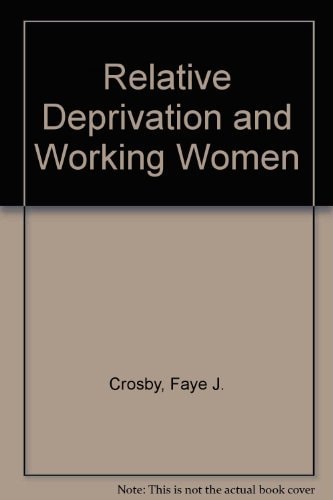
Relative Deprivation and Working Women
0
0
As an Amazon Associate and affiliate partner, Menrva Books earns from qualifying purchases. Learn more
Author Description
This book reports the results of a three-year intensive interview study of more than 400 working women, working men, and housewives, undertaken to evaluate and refine the theory of relative deprivation. The theory proposes that one's resentments and dissatisfactions are not simply a function of one's objective situation, but depend on a variety of cognitive and emotional factors. Crosby concludes that felt grievances depend directly on the individual's wants and feelings of entitlement, and explains how the theory of relaitve deprivation accounts for the female worker who expresses satisfaction with an objectively unsatisfactory situation.
Menrva's Summary
THE THESIS
This book investigates the psychological mechanisms behind why individuals experience dissatisfaction or resentment, specifically focusing on the theory of relative deprivation among working women. Faye J. Crosby utilizes a rigorous three-year empirical study to challenge the assumption that objective circumstances alone dictate personal grievance. By analyzing the interplay between cognitive appraisal, personal expectations, and feelings of entitlement, the author constructs a framework to explain why individuals may report satisfaction despite objectively inequitable working conditions.
THE SCOPE MAP
What You Will Find
- A comprehensive three-year longitudinal interview study involving over 400 participants.
- Comparative analysis between working women, working men, and housewives.
- A refined theoretical model of relative deprivation based on cognitive and emotional variables.
- Empirical evidence explaining the psychological disconnect between objective status and subjective contentment.
THE AUTHORITY PERSPECTIVE
Experts in sociology and organizational psychology recognize this work as a foundational text for understanding the cognitive dimensions of workplace inequality. Readers frequently note the academic density of the prose, which serves as a primary resource for scholars examining gendered perceptions of labor and entitlement.
Page Count:
268
Publication Date:
1982-09-23
Publisher:
Oxford University Press
ISBN-10:
0195031474
ISBN-13:
9780195031478
Psychology
Gender Studies
Women
Job satisfaction
Labor Studies
Sociology
Social Science
Community Tags
Similar Books