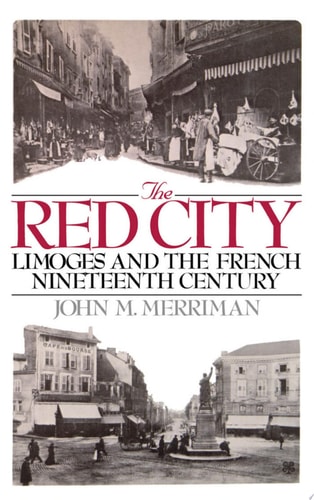
The Red City: Limoges and the French Nineteenth Century
0
0
As an Amazon Associate and affiliate partner, Menrva Books earns from qualifying purchases. Learn more
Author Description
This imaginative study recaptures 100 years in the life of Limoges, France's first socialist city, at a time when Limoges rode high on the crest of every wave of social, political, and industrial change. The story of this single city is the story of urban transformation and political radicalism in 19th-century France, of the struggle between tradition and modernity in French society and politics that took place not only within cities but also between cities and the countryside. Here, Merriman offers vivid portraits of particular social groups, neighborhoods, and events in 19th-century Limoges to describe and analyze the impact of large-scale industrialization, the social bases of political conflict, and the eventual emergence of a powerful working class. The central characters of Merriman's study are the very ordinary denizens of this extraordinary city--its butchers, porcelain workers, laundresses, priests--through whom one sees the effects of urbanization and industrialization on their quarters, work, religion, culture, and political life. The close of the 19th century marked the end of one of France's last truly revolutionary situations, concludes Merriman, as growing centralization dampened revolutionary zeal and the 20th century ushered in a combination of industrial capitalism and a powerful state that was seemingly invulnerable to revolutionary challenges from the working class.
Menrva's Summary
THE THESIS
This study investigates how Limoges transformed into France's first socialist city through the lens of 19th-century industrialization and urban change. John M. Merriman, a noted historian of modern France, utilizes archival research and social analysis to examine the friction between traditional structures and emerging modern political radicalism. By focusing on the daily lives of the city's inhabitants, he argues that the local struggle for identity and labor rights serves as a microcosm for the broader evolution of French society during this era.
THE SCOPE MAP
What You Will Find
- Analysis of 19th-century urban transformation and industrialization in Limoges.
- Examination of the social bases of political conflict among butchers, porcelain workers, and laundresses.
- Historical documentation of the tension between urban centers and the surrounding countryside.
- Evaluation of the decline of revolutionary zeal due to state centralization and industrial capitalism.
THE AUTHORITY PERSPECTIVE
Historians frequently cite this work as a foundational text for understanding the intersection of local social history and national political movements in France. Scholars note the depth of the research into the specific neighborhoods and social strata of Limoges, providing a clear model for urban historical analysis.
Page Count:
332
Publication Date:
1985-01-01
Publisher:
Oxford University Press
ISBN-10:
0195035909
ISBN-13:
9780195035902
History
French History
European History
Social History
Political History
Urban Studies
Community Tags
Similar Books