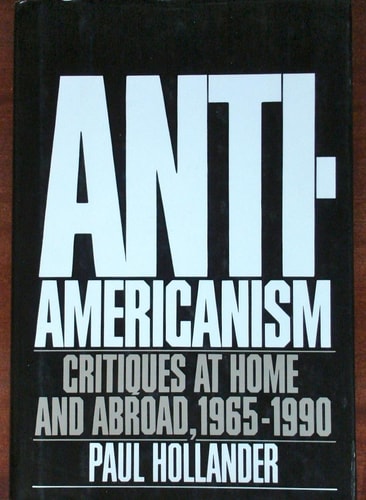
Anti-Americanism: Critiques at Home and Abroad, 1965-1990
0
0
As an Amazon Associate and affiliate partner, Menrva Books earns from qualifying purchases. Learn more
Author Description
Why is it that while millions of people all over the world dream about living in the United States, many American intellectuals believe that this is a uniquely deformed and unjust society? Why do college students today have greater pride in their country than many of their teachers? How did the radical beliefs of the '60s survive and become, for many Americans, the new conventional wisdom? How is it possible that while communist systems are collapsing and seek a market economy, critics in the United States remain convinced of the evils of capitalism? Why are there more Marxists on any handful of American campuses than all over Eastern Europe or the Soviet Union? How can we explain that for important opinion makers at home and abroad, the United States has become a symbol of waste, greed, corruption, social injustice, and arrogance?While anti-Americanism abroad has been often noted and sometimes lamented, until now it has not been closely examined nor compared to domestic social criticism. Paul Hollander's volume is the first systematic study of this phenomenon both in its domestic and foreign aspects. Making use of a vast amount of information (ranging from surveys, mass media, popular culture, novels, the literature of social criticism, and social scientific studies), Hollander separates the justified critiques of the United States from anti-Americanism, which he defines as a biased predisposition against American society, culture, or U.S. foreign policy, an attitude he compares to other hostile predispositions such as sexism, racism, or anti-Semitism.Domestic anti-Americanism is found mostly among academic and literary intellectuals, the left-leaning clergy, and people associated with the mass media--more generally among those who came of age in the 1960s. Despite more than a decade of Republican presidents, the author argues that many taken-for-granted beliefs of our times can be traced back to the adversarial spirit of the '60s. What once was daring social criti
Menrva's Summary
THE THESIS
This volume investigates the origins and persistence of anti-American sentiment, questioning why domestic intellectuals and foreign critics maintain a hostile predisposition toward the United States despite global evidence of the nation's appeal. Paul Hollander, a sociologist specializing in political culture, examines the ideological shift that occurred during the 1960s. He argues that a specific adversarial spirit became institutionalized within academia, the media, and the clergy, effectively creating a persistent bias that equates American capitalism and culture with systemic injustice.
THE SCOPE MAP
What You Will Find
- A comparative analysis of domestic social criticism versus international anti-Americanism.
- A historical examination of the cultural and political climate from 1965 to 1990.
- Extensive use of primary sources including surveys, mass media reports, popular culture, and academic literature.
- A conceptual framework defining anti-Americanism as a biased predisposition comparable to other forms of prejudice.
THE AUTHORITY PERSPECTIVE
Experts recognize this work as a foundational text for understanding the intellectual history of the American New Left and its lasting influence on institutional discourse. Readers frequently note the academic density of the prose and the author's rigorous, albeit controversial, attempt to categorize social criticism as a form of ideological bias.
Page Count:
544
Publication Date:
1992-01-09
Publisher:
Oxford University Press
ISBN-10:
019503824X
ISBN-13:
9780195038248
History
Sociology
American Studies
Community Tags
Similar Books