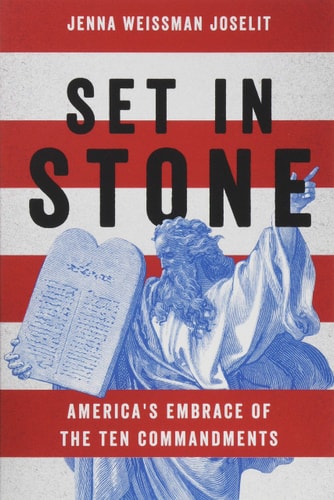
Set in Stone: America's Embrace of the Ten Commandments
0
0
As an Amazon Associate and affiliate partner, Menrva Books earns from qualifying purchases. Learn more
Author Description
When Cecil B. DeMille's epic, The Ten Commandments, came out in 1956, lines of people crowded into theaters across America to admire the movie's spectacular special effects. Thanks to DeMille, the commandments now had fans as well as adherents. But the country's fascination with the Ten Commandments goes well beyond the colossal scenes of this Hollywood classic.In this vividly rendered narrative, Jenna Weissman Joselit situates the Ten Commandments within the fabric of American history. Her subjects range from the 1860 tale of the amateur who claimed to have discovered ancient holy stones inside a burial mound in Ohio to the San Francisco congregation of Sherith Israel, which commissioned aluminous piece of stained glass depicting Moses in Yosemite for its sanctuary; from the Kansas politician Charles Walter, who in the late nineteenth century proposed codifying each commandment into state law, to the radio commentator Laura Schlessinger, who popularized the Ten Commandments as a psychotherapeutic tool in the 1990s.At once text and object, celestial and earthbound, Judaic and Christian, the Ten Commandments were not just a theological imperative in the New World; they also provoked heated discussions around key issues such as national identity, inclusion, and pluralism. In a country as diverse and heterogeneous as the United States, the Ten Commandments offered common ground and held out the promise of order and stability, becoming the lodestar of American identity. While archaeologists, theologians, and devotees across the world still wonder what became of the tablets that Moses received on Mount Sinai, Weissman Joselit offers a surprising answer: they landed in the United States.
Menrva's Summary
THE THESIS
This book investigates how the Ten Commandments evolved from a theological imperative into a central, often contested, symbol of American national identity. Jenna Weissman Joselit, a historian of American Jewish life, utilizes a wide array of cultural artifacts and historical anecdotes to trace the commandments' integration into the American social fabric. She argues that the tablets served as a mechanism for navigating complex issues of pluralism, order, and stability throughout the nineteenth and twentieth centuries.
THE SCOPE MAP
What You Will Find
- Historical analysis of the Ten Commandments in American public life from the 1860s to the 1990s.
- Case studies ranging from archaeological hoaxes in Ohio to stained glass art in San Francisco.
- Examination of the commandments as both a religious text and a secular cultural object.
Scope Limits
- The book does not provide a theological exegesis of the commandments themselves.
- It does not focus on the original biblical context or the archaeological search for the historical tablets in the Middle East.
THE AUTHORITY PERSPECTIVE
Scholars and critics recognize this work as a nuanced exploration of how religious symbols are repurposed within secular political discourse. Readers frequently note the accessible, narrative-driven prose that effectively connects disparate historical events into a cohesive cultural study.
Page Count:
232
Publication Date:
2019-10-01
Publisher:
Oxford University Press
ISBN-10:
0190088419
ISBN-13:
9780190088415
History
Religion
American History
American Studies
Church History
Reference
Bibles
New Used & Rental Textbooks
Church Leadership
Sociology
Americas
Cultural History
Bible Study
United States
Community Tags
Similar Books