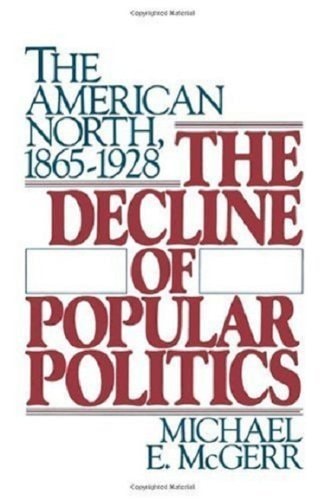
The Decline of Popular Politics: The American North, 1865-1928
0
0
As an Amazon Associate and affiliate partner, Menrva Books earns from qualifying purchases. Learn more
Author Description
In the 1984 presidential election, only half of the eligible electorate exercised its right to vote. Why does politics no longer excite many--of not most Americans?Michael McGerr attrributes the decline in voting in the American North to the transformation of political style after the Civil War. The Decline of Popular Politics vividly recreates a vanished world of democratic ritual and charts its disappearance in the rapid change of industrial society.A century ago, political campaigns meant torchlight parades, spectacular pageants staged by opposing parties, and crowds of citizens attired in military dress or proudly displaying their crafts at well-attended rallies. The intense partisanship of presidential campaigns and party newspapers made political choice easy for people from all walks of life. In the late 1860s and 1870s, however, the rise of liberalism led to a rejection of partisanship by the press and a move towards "educational," rather than spectacular, electioneering. This style then lost out at the turn of the century to the sensational journalism of Joseph Pulitzer and William Randolph Hearst, and the "advertised" campaigning of Mark Hanna and other politicians. McGerr shows how these new developments made it increasingly difficult for many Northerners to link their political impulses with political action. By the 1920s, Northern politics resembled our own public life today. A vital democratic culture had yielded to advertised campaigns, an emphasis on personalities rather than issues or partisanship, and low voter turnout.About the Author:Michael E. McGerr is Assistant Professor of History at the Massachusetts Institute of Technology.
Menrva's Summary
THE THESIS
This work investigates the historical transition in American political culture that led to the decline of voter participation and the erosion of partisan engagement in the North between 1865 and 1928. Michael E. McGerr, a historian, utilizes archival research and political analysis to argue that the shift from spectacular, ritualized campaigning to modern, advertised politics fundamentally altered the relationship between citizens and the state. He examines how the rise of liberalism, the evolution of journalism, and the professionalization of campaign tactics dismantled the vibrant democratic culture of the post-Civil War era.
THE SCOPE MAP
What You Will Find
- Analysis of the transformation of political campaigning from the 1860s through the 1920s.
- Examination of the impact of sensationalist journalism and the rise of mass media on political discourse.
- Historical evidence regarding the decline of voter turnout in the American North.
- Evaluation of the shift from party-centered partisanship to personality-driven political advertising.
THE AUTHORITY PERSPECTIVE
Historians and political scientists frequently cite this text as a foundational study for understanding the structural changes in American electoral behavior. Scholars often highlight the clarity of the author's argument regarding the professionalization of politics and its long-term effects on democratic participation.
Page Count:
307
Publication Date:
1986-02-27
Publisher:
Oxford University Press
ISBN-10:
0195036824
ISBN-13:
9780195036824
History
Sociology
American History
Voting
19th Century
20th Century
Community Tags
Similar Books