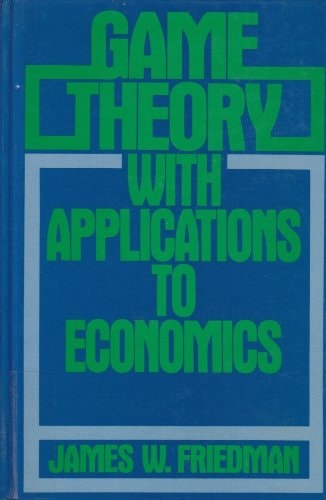
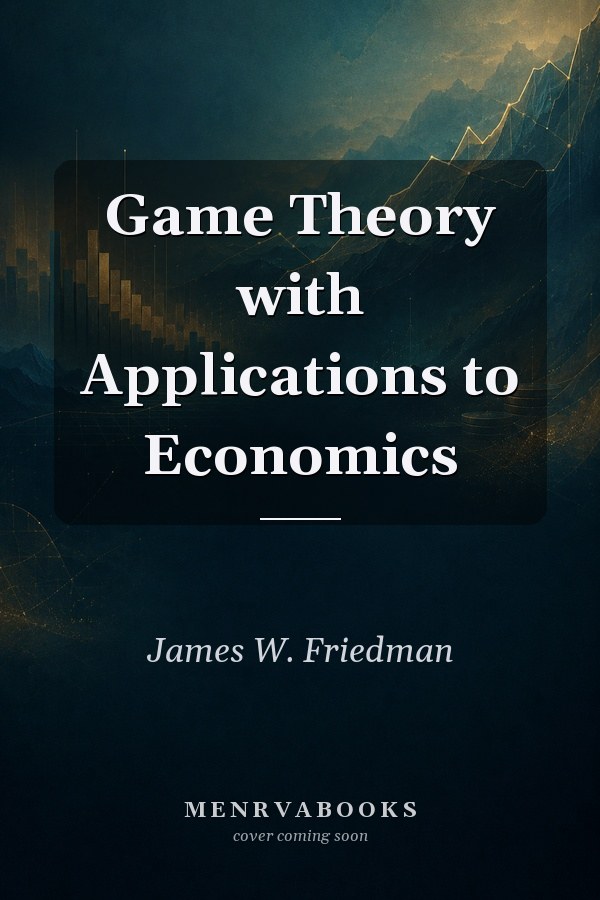
Game Theory with Applications to Economics
0
0
As an Amazon Associate and affiliate partner, Menrva Books earns from qualifying purchases. Learn more
Author Description
This comprehensive new text is an excellent introduction to game theory, acessible to undergraduate and graduate students with a moderate background in mathematics. Using examples from both economics and politics, it covers cooperative and non-cooperative game theory illustrating the breadth and depth of its influence on economics. The book begins with an introduction to the subject, followed by a chapter on two-person zero-sum games with (Nash) noncooperative equilibrium for n-person noncooperative games, touching on both uniqueness of equilibrium and on games of incomplete information. Middle chapters treat the most recent material on noncooperative supergames and trigger strategy equilibria, cooperation supported by self-enforcing agreements, and refinements of the Nash noncooperative equilibrium such as perfect equilibrium and sequential equilibrium. Later chapters cover two person cooperative games and solution concepts for cooperative games having transferable utility. The final chapter deals with the generalizations of the core and the Shapley value to nontransferable utility games. Realistic examples and problems from economic literature appear in every chapter, illustrating the wide scope of the theory's applications in economics.
Menrva's Summary
THE THESIS
This text investigates the application of game theory frameworks to economic and political decision-making processes. Author James W. Friedman provides a structured introduction to both cooperative and non-cooperative game theory, specifically tailored for undergraduate and graduate students with a moderate mathematical background. The book synthesizes theoretical concepts with practical economic literature to demonstrate how strategic interaction models explain market behavior and policy outcomes.
THE SCOPE MAP
What You Will Find
- Comprehensive coverage of two-person zero-sum games and n-person noncooperative equilibrium.
- Analysis of noncooperative supergames, trigger strategy equilibria, and self-enforcing agreements.
- Examination of cooperative game solution concepts, including transferable and nontransferable utility.
- Application of the core and Shapley value to complex economic scenarios.
THE AUTHORITY PERSPECTIVE
Experts recognize this work as a foundational text for students bridging the gap between basic economic theory and advanced strategic modeling. Readers frequently note the technical clarity of the prose, which balances rigorous mathematical proofs with illustrative examples from the field of economics.
Page Count:
264
Publication Date:
1986-03-06
Publisher:
Oxford University Press
ISBN-10:
0195036603
ISBN-13:
9780195036602
Economics
Mathematics
Economics Mathematical
Academic
Game theory
textbook
Community Tags
Other Editions(3)
Similar Books