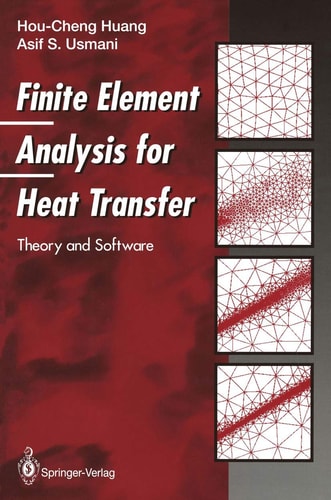
Finite Element Analysis for Heat Transfer Theory and Software
0
0
As an Amazon Associate and affiliate partner, Menrva Books earns from qualifying purchases. Learn more
Author Description
This text presents an introduction to the application of the finite ele ment method to the analysis of heat transfer problems. The discussion has been limited to diffusion and convection type of heat transfer in solids and fluids. The main motivation of writing this book stems from two facts. Firstly, we have not come across any other text which provides an intro duction to the finite element method (FEM) solely from a heat transfer perspective. Most introductory texts attempt to teach FEM from a struc tural engineering background, which may distract non-structural engineers from pursuing this important subject with full enthusiasm. We feel that our approach provides a better alternative for non-structural engineers. Secondly, for people who are interested in using FEM for heat transfer, we have attempted to cover a wide range of topics, presenting the essential the ory and full implementational details including two FORTRAN programs. In addition to the basic FEM heat transfer concepts and implementation, we have also presented some modem techniques which are being used to enhance the accuracy and speed of the conventional method. In writing the text we have endeavoured to keep it accessible to persons with qualifications of no more than an engineering graduate. As mentioned earlier this book may be used to learn FEM by beginners, this may include undergraduate students and practicing engineers. However, there is enough advanced material to interest more experienced practitioners.
Menrva's Summary
THE THESIS
This text introduces the application of the finite element method (FEM) to heat transfer problems, focusing on diffusion and convection in solids and fluids. The authors, Asif S. Usmani and Hou-Cheng Huang, aim to provide an accessible introduction to FEM specifically from a heat transfer perspective, distinguishing it from texts that emphasize structural engineering. The book covers essential theory and implementation details, including two FORTRAN programs, and explores modern techniques for enhancing accuracy and speed. It is designed for individuals with at least an engineering graduate qualification, serving beginners like undergraduate students and practicing engineers, while also offering advanced material for experienced practitioners.
THE SCOPE MAP
- Introduction to the Finite Element Method (FEM) from a heat transfer viewpoint.
- Application of FEM to diffusion type heat transfer problems in solids and fluids.
- Application of FEM to convection type heat transfer problems in solids and fluids.
- Detailed theoretical concepts of FEM for heat transfer.
- Full implementational details including two FORTRAN programs.
- Discussion of modern techniques to enhance accuracy and speed of FEM.
- Content suitable for undergraduate students and practicing engineers.
- Advanced material for experienced practitioners.
THE AUTHORITY PERSPECTIVE
The book is presented as a specialized introduction to Finite Element Method (FEM) for heat transfer, specifically designed to appeal to non-structural engineers by avoiding a structural engineering background. It aims to provide both the theoretical underpinnings and practical implementation details, including FORTRAN code, making it a resource for beginners and experienced practitioners alike. The authors' stated motivation is to fill a gap in existing literature by offering a dedicated heat transfer perspective on FEM. The text is intended to be accessible to those with an engineering graduate-level qualification.
Page Count:
199
Publication Date:
2012-01-06
Publisher:
Springer London
ISBN-10:
1447120922
ISBN-13:
9781447120926
Science
Non-Fiction
Heat Transfer
Engineering
Diffusion
Computational Methods