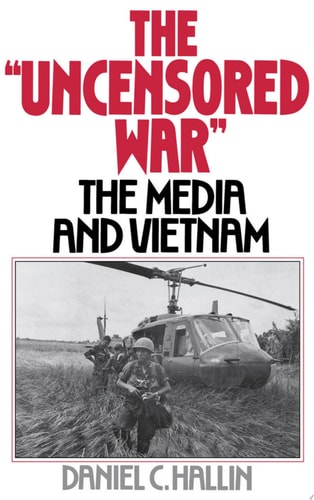
The Uncensored War: The Media and the Vietnam War
0
0
As an Amazon Associate and affiliate partner, Menrva Books earns from qualifying purchases. Learn more
Author Description
Vietnam was America's most divisive and unsuccessful foreign war. It was also the first to be televised and the first of the modern era fought without military censorship. From the earliest days of the Kennedy-Johnson escalation right up to the American withdrawal, and even today, the media's role in Vietnam has continued to be intensely controversial. The "Uncensored War" gives a richly detailed account of what Americans read and watched about Vietnam. Hallin draws on the complete body of the New York Times coverage from 1961 to 1965, a sample of hundreds of television reports from 1965-73, including television coverage filmed by the Defense Department in the early years of the war, and interviews with many of the journalists who reported it, to give a powerful critique of the conventional wisdom, both conservative and liberal, about the media and Vietnam. Far from being a consistent adversary of government policy in Vietnam, Hallin shows, the media were closely tied to official perspectives throughout the war, though divisions in the government itself and contradictions in its public relations policies caused every administration, at certain times, to lose its ability to "manage" the news effectively. As for television, it neither showed the "literal horror of war," nor did it play a leading role in the collapse of support: it presented a highly idealized picture of the war in the early years, and shifted toward a more critical view only after public unhappiness and elite divisions over the war were well advanced. The "Uncensored War" is essential reading for anyone interested in the history of the Vietnam war or the role of the media in contemporary American politics.
Menrva's Summary
THE THESIS
This book investigates the extent to which media coverage influenced public opinion and government policy during the Vietnam War. Daniel C. Hallin, a scholar of political communication, utilizes a rigorous analysis of archival news reports and primary source interviews to challenge the prevailing myth that the media acted as an independent adversary to the state. He argues that journalistic output was fundamentally tethered to official government perspectives, only shifting toward criticism when internal elite consensus began to fracture.
THE SCOPE MAP
What You Will Find
- Comprehensive analysis of New York Times coverage from 1961 to 1965.
- Systematic review of television news reports spanning 1965 to 1973.
- Primary source interviews with journalists who covered the conflict on the ground.
- Examination of the relationship between government public relations management and news production.
THE AUTHORITY PERSPECTIVE
Experts frequently cite this work as a foundational text for understanding the intersection of media and military conflict. Readers note the academic density of the prose, which provides a detailed, evidence-based counter-narrative to popular myths regarding the media's role in the Vietnam War.
Page Count:
293
Publication Date:
1986-05-08
Publisher:
Oxford University Press
ISBN-10:
0195038142
ISBN-13:
9780195038149
History
Military History
Vietnam War
Media Studies
Journalism
Community Tags
Similar Books