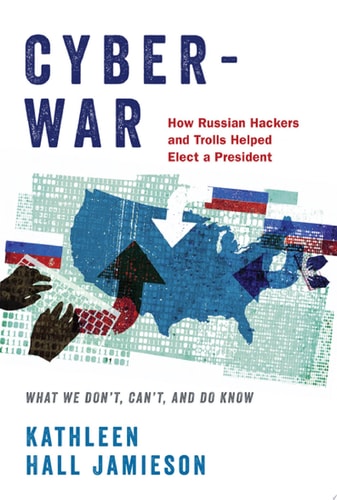
Cyberwar: How Russian Hackers and Trolls Helped Elect a President: What We Don't, Can't, and Do Know
0
0
As an Amazon Associate and affiliate partner, Menrva Books earns from qualifying purchases. Learn more
Author Description
The question of how Donald Trump won the 2016 election looms over his presidency. In particular, were the 78,000 voters who gave him an Electoral College victory affected by the Russian trolls and hackers? Trump has denied it. So has Vladimir Putin. Others cast the answer as unknowable. In Cyberwar, Kathleen Hall Jamieson marshals the troll posts, unique polling data, analyses of how the press used hacked content, and a synthesis of half a century of media effects literature to argue that, although not certain, it is probable that the Russians helped elect the 45th president of the United States. In the process, she asks: How extensive was the troll messaging? What characteristics of social media did the Russians exploit? Why did the mainstream press rush the hacked content into the citizenry's newsfeeds? Was Clinton telling the truth when she alleged that the debate moderators distorted what she said in the leaked speeches? Did the Russian influence extend beyond social media and news to alter the behavior of FBI director James Comey? After detailing the ways in which Russian efforts were abetted by the press, social media, candidates, party leaders, and a polarized public, Cyberwar closes with a warning: the country is ill-prepared to prevent a sequel. In this updated paperback edition, Jamieson covers the many new developments that have come to light since the original publication.
Menrva's Summary
THE THESIS
This book investigates whether Russian interference through hacking and social media manipulation significantly influenced the outcome of the 2016 United States presidential election. Kathleen Hall Jamieson, a scholar of political communication, utilizes a combination of polling data, analysis of media coverage, and historical media effects literature to construct her argument. She posits that while absolute certainty is elusive, the evidence suggests a high probability that Russian efforts contributed to the electoral result by exploiting existing political polarization and media vulnerabilities.
THE SCOPE MAP
What You Will Find
- Analysis of Russian troll messaging strategies and social media exploitation.
- Examination of how mainstream media outlets disseminated hacked content.
- Synthesis of media effects research applied to modern digital campaigning.
- Investigation into the influence of leaked speeches on public perception and candidate behavior.
Scope Limits
- The book does not provide a definitive, legally binding proof of election outcome alteration.
- It does not cover the entirety of global cyberwarfare tactics beyond the scope of the 2016 US election.
THE AUTHORITY PERSPECTIVE
Experts and political analysts frequently cite this work for its rigorous methodological approach to analyzing complex media influence. Readers often note the academic density of the prose, which provides a detailed, evidence-based examination of the intersection between digital interference and democratic processes.
Page Count:
400
Publication Date:
2020-06-03
Publisher:
Oxford University Press
ISBN-10:
0190058838
ISBN-13:
9780190058838
History
Politics
United States
Cybersecurity
Russia
Systems Theory
Elections & Political Process
Media Studies
Politics & Government
New Used & Rental Textbooks
Comparative Politics
Mass media
World politics
Law
Journalism
Community Tags
Similar Books