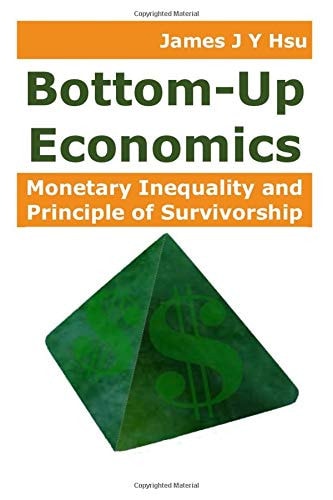
Bottom-Up Economics: Monetary Inequality and the Principle of Survivorship
0
0
As an Amazon Associate and affiliate partner, Menrva Books earns from qualifying purchases. Learn more
Author Description
This book explores the economic principles of wealth disparity with use of the computer simulation by the Monte Carlo method, and shows that the underlying economic force causing wealth disparity is monetary inequality, namely, the earning power of a rich person's dollar, in a statistically averaged sense, is much greater than that of a poor person's dollar. This is consistent with the maxim that the second million is easier. The monetary inequality is not all evil. It can be the driving force for creating wealth, which can be fast and furious to lift a huge population out of poverty in a short time. However, monetary inequality may also result from political influence money can buy to transfer wealth from the public to the rich, and from monopoly power in the market position to transfer wealth from the poor to the rich. Given the limited resources within the bounded domain for a capitalist society, no enterprise is truly free. Without considering the load on the real world and vice versa, capitalism has the intrinsic characteristics incompatible with our social conscience and democratic values, namely, unsustainability, monopolistic beneficiary, rentier oppression, and corporate dictatorship. Nurturing an economy has to be like building a pyramid. It needs a broad and solid base in order to reach the great new height. The bottom-up economics based on the Principle of Survivorship -- defined in this book as each person being assured the means to survive the economic challenges in his/her working life and a nonnegative asset at retirement -- will support a strong and stable economy and would move toward vivid democracy, vibrant capitalism, egalitarian wealth, and creativity-inspired products.
Menrva's Summary
THE THESIS
This book investigates the fundamental drivers of economic inequality and proposes a framework for a more sustainable and equitable capitalist system. The author, Jang-Yu Hsu, utilizes Monte Carlo simulations to demonstrate that monetary inequality, specifically the greater earning power of a wealthy person's dollar, is the primary cause of wealth disparity. While acknowledging that this inequality can fuel economic growth and lift populations out of poverty, the book also critically examines how political influence and monopoly power can exacerbate it, leading to unsustainability, rentier oppression, and corporate dictatorship. The core argument posits that a robust economy requires a broad and solid foundation, advocating for 'bottom-up economics' based on the Principle of Survivorship.
THE SCOPE MAP
- Exploration of economic principles of wealth disparity using Monte Carlo simulations.
- Analysis of monetary inequality as the underlying economic force causing wealth disparity.
- Discussion of how monetary inequality can drive wealth creation and poverty reduction.
- Examination of political influence and monopoly power as mechanisms for wealth transfer.
- Critique of capitalism's intrinsic characteristics: unsustainability, monopolistic beneficiary, rentier oppression, and corporate dictatorship.
- Introduction and definition of the 'Principle of Survivorship' as a foundation for economic stability.
- Advocacy for 'bottom-up economics' to support a strong and stable economy and foster vivid democracy, vibrant capitalism, egalitarian wealth, and creativity.
THE AUTHORITY PERSPECTIVE
The book's approach, utilizing computer simulations to analyze economic principles, suggests a data-driven and analytical perspective on wealth disparity. The author's critique of capitalism and proposal for 'bottom-up economics' indicate a focus on systemic issues and potential solutions for fostering a more equitable society. The framing of the 'Principle of Survivorship' as a cornerstone for economic health and democratic values points to a prescriptive and forward-looking argument. The text appears designed to engage readers interested in the structural causes of economic inequality and alternative economic models.
Page Count:
312
Publication Date:
2019-01-01
Publisher:
Independently Published
ISBN-10:
1798500035
ISBN-13:
9781798500033
Non-Fiction
Economics
Democracy
Capitalism
Community Tags
Similar Books