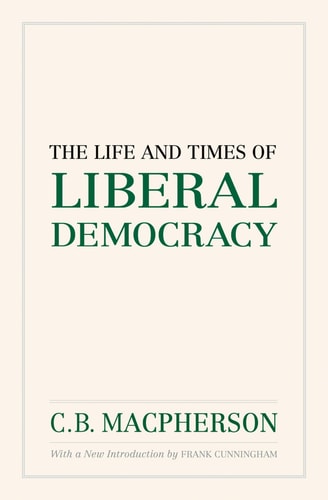
The Life and Times of Liberal Democracy
0
0
As an Amazon Associate and affiliate partner, Menrva Books earns from qualifying purchases. Learn more
Author Description
The author traces the background of current liberal-democratic theory, explains how the concept of democracy became both embedded in the shifting ideas of social equality and increasingly dependent on the mechanism of capitalism, and points the way to a more participatory democracy.
Menrva's Summary
THE THESIS
How did the concept of liberal democracy evolve to become inextricably linked with capitalist economic structures, and what alternatives exist for a more participatory future? C. B. Macpherson, a prominent political theorist, examines the historical trajectory of liberal-democratic thought from the seventeenth century to the modern era. He argues that the development of these theories was fundamentally shaped by the requirements of a market society, which prioritized individual property rights and competitive accumulation over broader democratic participation. By analyzing the works of key political philosophers, Macpherson identifies the logical contradictions inherent in current democratic models.
THE SCOPE MAP
What You Will Find
- Historical analysis of liberal-democratic theory from the 17th century to the 20th century
- Critical examination of the relationship between market capitalism and democratic governance
- Theoretical framework for participatory democracy
- Critique of possessive individualism
Scope Limits
- Does not provide a practical policy manual for immediate implementation
- Focuses primarily on Western political thought rather than global comparative systems
THE AUTHORITY PERSPECTIVE
Scholars and political scientists frequently cite this work as a foundational text for understanding the tensions between liberal individualism and democratic equality. Readers often note the academic density of the prose, which requires a solid grasp of political philosophy to fully synthesize the author's arguments.
Page Count:
128
Publication Date:
1978-01-05
Publisher:
Oxford University Press
ISBN-10:
0192891065
ISBN-13:
9780192891068
History
Philosophy
Democracy
Political Theory
Capitalism