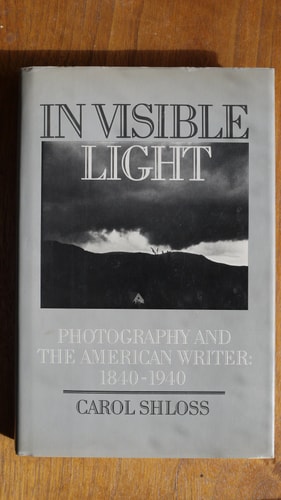
In Visible Light: Photography and the American Writer, 1840-1940
0
0
As an Amazon Associate and affiliate partner, Menrva Books earns from qualifying purchases. Learn more
Author Description
This is a book about the way that artists--both writers and photographers--approach their subjects and the choices they must make in creating art from their perceptions of other people's lives and experiences.For the photographer, Carol Shloss notes, these choices come at the actual moment when he stands before his subject, seeking to capture it in some way within the technical limitations of the camera frame. For the writer--particularly the writer who chooses to seek out others and to make art from "opening up" to the presence of another person--the choices made are more hidden but nevertheless similar to the ones faced by the photographer: Shloss shows how the process of constituting a text and finding its material is in many ways like using a camera. Throughout, Shloss stresses the significance of the relationship between artist and subject, noting, "Whatever its desired end, art is drawn out of separateness and...the artist's terms of engagement with his or her subject are manifold, with referents in fear and in hope, in desire, fascination and hunger."Filled with fascinating glimpses into the ways both writers and photographers work, the book explores the links between the two in chapters on Hawthorne and daguerreotypy; Henry James and Alvin Langdon Coburn; Theodore Dreiser, Alfred Stieglitz, and Jacob Riis; John Dos Passos and the Soviet cinema; James Agee and Walker Evans; John Steinbeck and Dorothea Lange; and Norman Mailer and World War II combat photography (especially that of Robert Capa and Margaret Bourke-White). Illustrated with some 40 photos, In Visible Light reveals in penetrating detail the values that underpin literature and photography, demonstrating that "art and politics are of the same metaphysical substance."
Menrva's Summary
THE THESIS
This book investigates the parallel creative processes and ethical considerations shared by American writers and photographers between 1840 and 1940. Carol Shloss, an academic and literary scholar, examines how the act of capturing a subject through a camera lens mirrors the writer's endeavor to document human experience. She argues that both mediums rely on a complex, often fraught relationship between the artist and the subject, rooted in the shared metaphysical substance of art and politics.
THE SCOPE MAP
What You Will Find
- Analysis of the intersection between literary composition and photographic technique.
- Case studies of historical pairings including Hawthorne, Henry James, John Steinbeck, and James Agee.
- Examination of the evolution of visual documentation from daguerreotypy to mid-twentieth-century combat photography.
- Theoretical exploration of the artist's engagement with their subject matter through the lenses of desire, fascination, and political intent.
THE AUTHORITY PERSPECTIVE
Scholars and critics frequently cite this work as a foundational text for understanding the visual culture of American literature. Readers often note the academic density of the prose, which provides a rigorous framework for analyzing the symbiotic relationship between text and image.
Page Count:
320
Publication Date:
1987-04-09
Publisher:
Oxford University Press
ISBN-10:
0195038932
ISBN-13:
9780195038934
Non-Fiction
Photography
American fiction
Literary Criticism
American
Art History
Community Tags
Similar Books