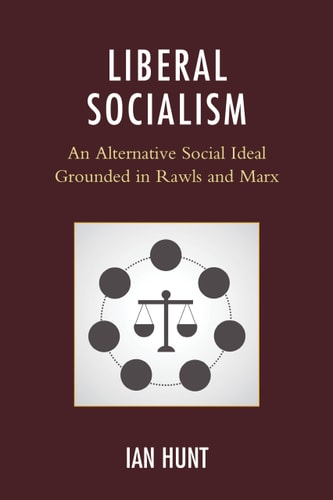
Liberal Socialism: An Alternative Social Ideal Grounded in Rawls and Marx
0
0
As an Amazon Associate and affiliate partner, Menrva Books earns from qualifying purchases. Learn more
Author Description
Should we be looking for alternatives to the western world’s status quo of neo-liberal capitalism? Should we be seeking a new form of freedom for a more just and better social world? Drawing on Rawls’s theory of justice and Marx’s critique of capitalism, this book answers those questions in a resounding affirmative. Some think that a just society for Rawls cannot promote a better social world unless it is acceptable to all but, this wrongly treats Rawls as a supporter of minimal government. Setting this aside, the book argues that the ideas of justice behind political and media support of neo-liberal capitalism are faulty, and should be replaced with a Rawlsian idea of justice. Resistance to the idea that an acceptable theory of justice can say that capitalism is unjust is overcome by showing that capitalism, as Marx sees it, must be unjust on Rawls’s theory of justice because it breaches the difference principle and involves exploitation of employees. Reasons are then given for a new society that will be just under a modified Rawlsian idea of justice and will promote the Marxian good of free social cooperation on projects pursued independently of demands of nature. What a free life lived in this new society means is spelled out and shown to be acceptable. This book concludes by asking whether society can set out on a path to a better social world.
Menrva's Summary
THE THESIS
This book investigates whether alternatives to neo-liberal capitalism can foster a more just and better social world. Drawing on John Rawls's theory of justice and Karl Marx's critique of capitalism, the author argues for a resounding affirmative. It challenges the notion of Rawls as a proponent of minimal government and asserts that the prevailing ideas of justice supporting neo-liberal capitalism are flawed. The book contends that capitalism is inherently unjust under Rawls's theory because it violates the difference principle and involves employee exploitation, proposing a new society based on a modified Rawlsian framework that promotes Marxian free social cooperation.
THE SCOPE MAP
- Analysis of John Rawls's theory of justice and its application to contemporary capitalism.
- Critique of Karl Marx's analysis of capitalism and its relevance to social justice.
- Examination of the flaws in current political and media support for neo-liberal capitalism.
- Argument for a Rawlsian idea of justice as a replacement for existing frameworks.
- Demonstration of how capitalism breaches Rawls's difference principle and involves exploitation.
- Proposal for a new society grounded in a modified Rawlsian idea of justice.
- Exploration of the Marxian concept of free social cooperation on projects independent of natural demands.
- Definition and assessment of a free life within the proposed new society.
THE AUTHORITY PERSPECTIVE
The book presents a rigorous philosophical argument, likely appealing to academics and students of political theory, philosophy, and economics. Its engagement with foundational thinkers like Rawls and Marx suggests a text that will stimulate debate within these fields. The author's approach of synthesizing disparate theoretical frameworks to propose a novel social ideal indicates a work intended to provoke critical thought on the status quo. The concluding question about society's path forward invites further reflection and discussion on the practical implementation of such ideals.
Page Count:
182
Publication Date:
2015-10-22
Publisher:
Bloomsbury Academic
ISBN-10:
1498506534
ISBN-13:
9781498506533
Non-Fiction
Philosophy
Socialism
Capitalism
Justice
Marxism
Political Philosophy
Community Tags
Similar Books