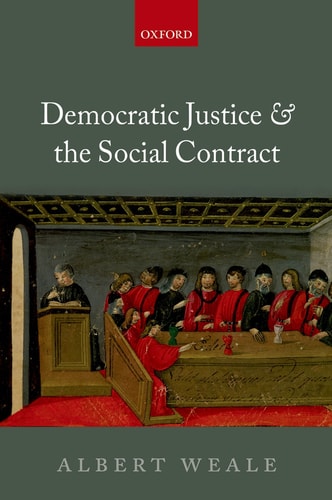
Democratic Justice and the Social Contract
0
0
As an Amazon Associate and affiliate partner, Menrva Books earns from qualifying purchases. Learn more
Author Description
This book offers a theory of democratic justice. According to the theory, justice emerges from collective agreement among political associates who enjoy approximate equality of power. Such situations can be seen as social contracts, and we find an empirical model for social contracts in the examples of successful common property resource regimes. In these regimes, participants craft collective rules of access to the means of production on an equal basis and producers are entitled to the full fruits of their labour. To interpret this theoretically an account of practical rationality in terms of individual and public deliberation is required.In tracing the move from small scale to large scale societies, three important transformations become apparent: in political institutions; in the economy; and in the functions of the household. All are relevant to the understanding of justice. In great societies representative parties making policy and law in shifting coalitions in parliaments elected by proportional representation exemplify political equality and so instance one form of democratic justice. In the economy corporate hierarchies modify the full fruits principles, not always in the direction of justice. Redistribution is justified as a means of smoothing income across the life-cycle, rather than by appeal to economies of scale or a simple principle of need.The sense of democratic justice requires commitment to the maintenance of those institutions that protect common interests, whilst acknowledging where there are differences of interest. This sense of democratic justice needs to be upheld by effective governance.
Menrva's Summary
THE THESIS
This book investigates the theoretical foundations of democratic justice by proposing that it emerges from collective agreements among political associates with approximate equality of power. Albert Weale, a distinguished political theorist, utilizes the framework of social contract theory to analyze how justice functions within both small-scale common property regimes and large-scale modern societies. He argues that practical rationality, expressed through individual and public deliberation, is essential for maintaining the institutions that protect common interests while navigating inherent differences in society.
THE SCOPE MAP
What You Will Find
- An empirical model of social contracts based on common property resource regimes.
- An analysis of the transition from small-scale to large-scale societal structures.
- A critical examination of political institutions, economic hierarchies, and household functions.
- A justification for income redistribution based on life-cycle smoothing rather than simple need.
THE AUTHORITY PERSPECTIVE
Scholars in political philosophy recognize this work as a rigorous attempt to bridge the gap between abstract social contract theory and the practical realities of modern democratic governance. Readers frequently note the academic density of the prose, which requires a strong background in political theory to fully appreciate the author's nuanced arguments.
Page Count:
352
Publication Date:
2013-09-15
Publisher:
Oxford University Press
ISBN-10:
0199684642
ISBN-13:
9780199684649
Economics
Governance
Political Philosophy
Justice
Community Tags
Similar Books