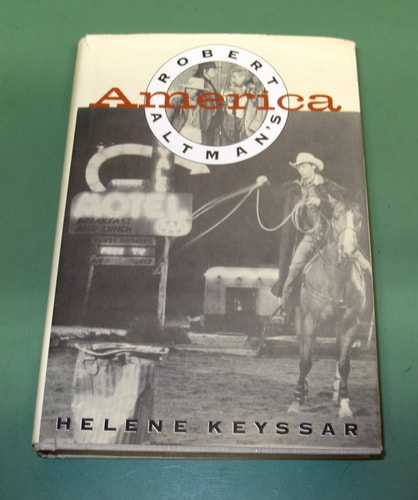
Robert Altman's America
0
0
As an Amazon Associate and affiliate partner, Menrva Books earns from qualifying purchases. Learn more
Author Description
Robert Altman is the most quintessentially American of contemporary directors. His films cut across virtually all genres--from Western (McCabe and Mrs. Miller) and science fiction (Quintet) to detective story (The Long Goodbye) and musical (Popeye)--offering us what Vincent Canby once called a "Gallery of American Portraits." And though few of his movies have met with huge commercial success (apart from the blockbuster M*A*S*H) Altman's unique vision of our society, his distinctive directorial signature, and his defiance of conventional film "language" have all helped reinvent the way we look at America. In Robert Altman's America Helene Keyssar shows why it is time we consider this unusual auteur among the pantheon of great directors. Informed by a vast knowledge of both film history and the most up-to-date critical theory, Keyssar offers a new and much-needed context for evaluating and understanding Altman's ouevre. Divided into five sections, Robert Altman's America identifies the peculiarities of the Altman style, discusses his films from both a feminist and political perspective, and offers a chapter-length discussion of one of his most important films, the 1975 Nashville, a "gleeful vision of an American landscape perpetually exploding upon itself." An especially helpful film chronology is also included in an appendix. Through the course of the book, Keyssar shows how Altman's approach to filmmaking subverts the very notion of the idea of "authorship," or of a single creative force behind a picture. While his point of view is always present, Altman's films are to a great extent the result of collaborative efforts with screenwriters, playwrights, and actors. His montage ofimages, the cacophonous intermingling of conversations--in essence, his deliberate ambiguity--undermine, Keyssar demonstrates, the singular authority of the director. Altman's lens, we come to recognize, is a dispassionate "penetrator of culture": his films do not tell us about America; rather
Menrva's Summary
THE THESIS
This work investigates how Robert Altman’s unique directorial style and collaborative filmmaking process fundamentally challenge traditional notions of cinematic authorship and reflect the complexities of American culture. Helene Keyssar, a scholar of film history and critical theory, utilizes a comprehensive analysis of Altman’s filmography to argue that his work functions as a dispassionate examination of societal structures. By examining his defiance of conventional film language, the author provides a framework for understanding Altman as a significant auteur whose films serve as a gallery of American portraits.
THE SCOPE MAP
What You Will Find
- A detailed analysis of Altman’s stylistic signatures, including his use of montage and overlapping dialogue.
- A critical examination of his filmography through feminist and political lenses.
- A dedicated chapter-length study of the 1975 film Nashville.
- A comprehensive film chronology provided in the appendix.
THE AUTHORITY PERSPECTIVE
Experts and film scholars recognize this text as a foundational study for understanding the mechanics of Altman’s collaborative approach to directing. Readers frequently note the academic density of the prose, which effectively bridges the gap between film history and contemporary critical theory.
Page Count:
400
Publication Date:
1991-11-28
Publisher:
Oxford University Press
ISBN-10:
0195048695
ISBN-13:
9780195048698
Non-Fiction
Biography
Cinema
Film Studies
Community Tags
Other Editions(2)
Similar Books







Reader Comments
Share Your Thoughts
No comments yet. Be the first to share your thoughts!