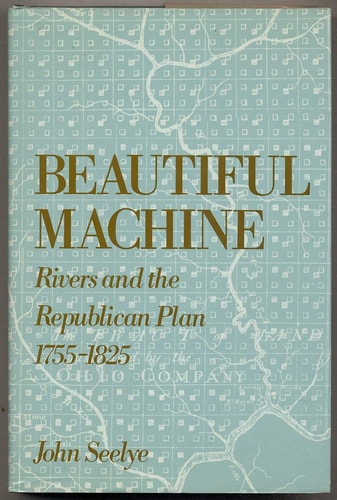
Beautiful Machine: Rivers and the Republican Plan, 1755-1825
0
0
As an Amazon Associate and affiliate partner, Menrva Books earns from qualifying purchases. Learn more
Author Description
This book, the second volume in Seelye's series on the rivers of America in the American imagination, explores how George Washington's vision of a "more perfect union" for America--based upon the linking of the nation's waterways by technical means--was carried out. The first volume, Prophetic Waters, dealt with the way rivers, especially in Virginia, influenced life and literature of the period. This book takes the story into the opening decades of the nineteenth century by showing, first, the exploration of the Ohio, Missouri, and Mississippi rivers, then the construction of the canals that connected these water systems, and finally, the creation of steamboats to navigate these Western rivers. Yet the net result, as Seelye shows, was quite different from, even antithetical to, Washington's original vision. Seelye ranges widely in the literature and personal narratives of the period to put these developments in an imaginative and cultural context.
Menrva's Summary
THE THESIS
This book investigates the discrepancy between George Washington's vision of a unified nation linked by internal waterways and the actual historical outcome of American expansion between 1755 and 1825. John Seelye, an established scholar of American cultural history, utilizes a wide array of personal narratives, literature, and historical records to analyze the development of the Ohio, Missouri, and Mississippi river systems. He argues that the technical implementation of canals and steamboats, intended to foster a cohesive republic, ultimately produced results that diverged significantly from Washington's original political and social intent.
THE SCOPE MAP
What You Will Find
- Exploration and mapping of the Ohio, Missouri, and Mississippi river systems.
- The engineering and construction history of early American canal systems.
- The cultural and technological impact of the introduction of steamboats.
- Analysis of primary source literature and personal accounts from the early nineteenth century.
THE AUTHORITY PERSPECTIVE
Scholars recognize this work as a significant contribution to the study of how infrastructure projects shaped the American imagination during the early republic. Readers frequently note the author's ability to synthesize technical history with literary analysis to provide a comprehensive view of the era.
Page Count:
448
Publication Date:
1991-10-10
Publisher:
Oxford University Press
ISBN-10:
0195045513
ISBN-13:
9780195045512
History
Transportation
American History
Cultural History
Geography
Rivers
Technology
Community Tags
Similar Books