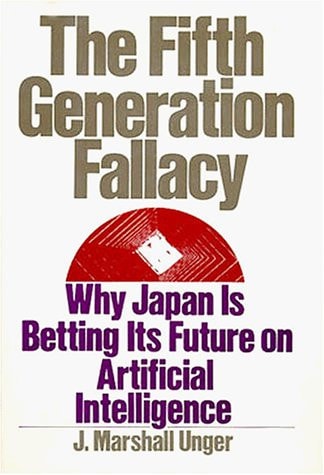
The Fifth Generation Fallacy: Why Japan is Betting Its Future on Artificial Intelligence
0
0
As an Amazon Associate and affiliate partner, Menrva Books earns from qualifying purchases. Learn more
Author Description
For several years a great deal of attention has been focused on Japan's highly publicized Fifth Generation Project, a research program aimed at the development of "intelligent" computers that can think like human beings. It has been claimed that such machines are the technology of the future, and that whoever gets them first will emerge as the new leader of the world economy.In this fascinating new book, J. Marshall Unger reveals that the West has completely misunderstood Japan's interest in Artificial Intelligence. Contrary to the common view of Japan's unassailable superiority in technology and business, perpetuated recently by popular books like Japan as Number One, Unger shows that Japanese researchers are less concerned with economic coups than with solving a fundamental problem concerning their notoriously difficult written language and the challenges it poses for computer technology. The complex mixture of Chinese and phonetic characters that make up the script can only laboriously be typewritten and so are resistant to one of the most basic of computer functions -- entering data into the machine's memory banks.Outlining the bewildering complexity of the Japanese script, which tested the limits of human intelligence even in bygone eras, Unger describes how in the modern age it has been the cause of disturbingly low levels of white-collar productivity and a surprisingly high degree of incomplete literacy in Japan. He goes on to demonstrate convincingly not only the ultimate incompatability of the script with existing computer technology but also the futility of the hope that AI, the goal of the hugely expensive Fifth Generation Project, will rescue the Japanese from this problem. He also explores the emotionally laden cultural mythology underlying Japanese resistance to script reform, which he points out is the obvious engineering solution to the drive to integrate computers into Japanese society. He concludes that the Japanese push towards AI and their refusal to reform their script is a strategic error.
Menrva's Summary
THE THESIS
This book investigates whether Japan's massive investment in the Fifth Generation Artificial Intelligence project is a strategic economic maneuver or a desperate, misguided attempt to solve the inherent incompatibility between the Japanese writing system and computer technology. J. Marshall Unger, an expert in Japanese linguistics, utilizes historical analysis and technical evaluation of computer input systems to challenge the prevailing Western narrative of Japanese technological dominance. He argues that the project is fundamentally flawed because it ignores the necessity of script reform in favor of pursuing an unattainable technological fix for a linguistic problem.
THE SCOPE MAP
What You Will Find
- An analysis of the technical limitations of the Japanese writing system in the context of data entry and computer processing.
- A historical overview of the Fifth Generation Project and its stated goals versus its practical outcomes.
- An examination of the cultural and emotional factors that prevent Japan from adopting script reform.
- A critique of the economic assumptions regarding Japan's technological superiority in the late 20th century.
THE AUTHORITY PERSPECTIVE
Experts in Japanese studies and technology policy cite this work as a critical counter-narrative to the techno-optimism surrounding Japan's industrial policy in the 1980s. Readers frequently note the author's rigorous focus on the intersection of linguistics and computing, which provides a unique lens for understanding the limitations of AI development.
Page Count:
240
Publication Date:
1987-10-08
Publisher:
Oxford University Press
ISBN-10:
019504939X
ISBN-13:
9780195049398
History
Technology
Japan
Sociology
Linguistics
Community Tags
Similar Books










Reader Comments
Share Your Thoughts
No comments yet. Be the first to share your thoughts!