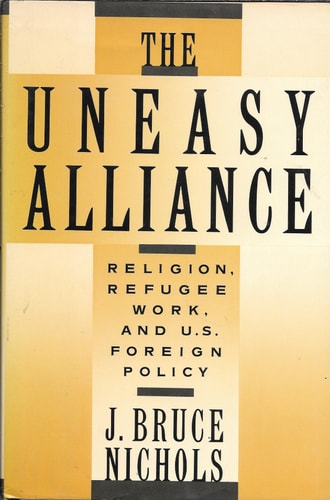
The Uneasy Alliance: Religion, Refugee Work, and U.S. Foreign Policy
0
0
As an Amazon Associate and affiliate partner, Menrva Books earns from qualifying purchases. Learn more
Author Description
With the plight of escalating numbers of refugees around the world growing more desperate every year, the American religious organizations dedicated to helping them are faced with an increasingly complicated relationship with the U.S. government. In this book, J. Bruce Nichols uncovers some disturbing facts and trends to demonstrate that the traditional separation of church and state in this country is not easily applied to the conduct of American foreign policy. Government has become increasingly dependent on the services of religious relief agencies for the implementation of refugee assistance. These agencies are for their part equally dependent on the government for funds, for strategic assistance, and for the freedom to function in many parts of the world. National security and foreign policy considerations often overwhelm humanitarian concerns. A number of hard questions emerge. Do certain religious groups receive preferential treatment for political reasons? Is the church/state relationship abroad compatible with constitutional guarantees of religious freedom? Have the refugees--and the religious groups helping them--become mere political pawns in the global power struggle? After reviewing the history of U.S. government relations with religious relief agencies, the author closely examines three politically explosive refugee situations: Honduras, Thailand, and the Sudan. As the Sanctuary trials in the United States have demonstrated, treatment of Salvadoran and Guatemalan refugees has been greatly complicated by the conflicting attitudes of liberal religious groups and the U.S. and Honduran governments. By contrast, an evangelical group working with Laotian refugees in Thailand found itself inadvertently embroiled in U.S. policy debates over Laos and Vietnam. While in the Sudan, Nichols discovers close ties between religious relief organizations and the U.S. government in the surreptitious and extra-legal manueverings to remove the Falashas.
Menrva's Summary
THE THESIS
This work investigates the complex and often contradictory intersection of American religious humanitarian organizations and the objectives of United States foreign policy. J. Bruce Nichols analyzes the historical and functional entanglement between government agencies and faith-based relief groups, arguing that the traditional separation of church and state is frequently compromised in the international arena. By examining the financial and strategic dependencies between these entities, the author questions whether humanitarian aid has become a tool for national security interests rather than an independent moral endeavor.
THE SCOPE MAP
What You Will Find
- Historical analysis of U.S. government relations with religious relief agencies.
- Case studies of refugee situations in Honduras, Thailand, and the Sudan.
- Examination of the political implications of the Sanctuary movement.
- Investigation into the use of religious groups as instruments of foreign policy and national security.
THE AUTHORITY PERSPECTIVE
Experts recognize this text as a critical examination of the blurred lines between humanitarianism and statecraft. Readers frequently note the detailed historical documentation provided by the author, which serves as a foundational resource for understanding the political pressures placed on religious organizations operating abroad.
Page Count:
352
Publication Date:
1988-05-12
Publisher:
Oxford University Press
ISBN-10:
0195042743
ISBN-13:
9780195042740
History
Religion
United States
International relations
Community Tags
Similar Books