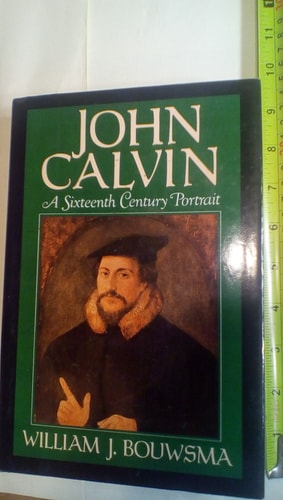
John Calvin: A Sixteenth-Century Portrait
0
0
As an Amazon Associate and affiliate partner, Menrva Books earns from qualifying purchases. Learn more
Author Description
Calvinism has been widely credited--or blamed--for much that is thought to characterize the modern world: for capitalism and modern science, for secularization and democracy, for individualism and utilitarianism. But John Calvin the man has been largely ignored by historians; most of us, if we think of him at all, tend to view him as little more than the joyless tyrant of Geneva and the source of an abstract theology as forbidding as its author. This book, by an eminent historian whose career has been devoted to understanding the larger patterns of early modern European history, aims to make Calvin come alive by putting him back in his own time and understanding how he dealt with its problems.A Frenchman, an exile, and a humanist in the tradition of Erasmus, Calvin was unusually sensitive to the complexities and contradictions of later Renaissance culture. The Calvin who emerges from this eloquent study is a surprisingly human, more plausible, more ecumenical, and often sympathetic figure, whose achievement was both more and less than -- and at the same time quite different from -- the way it has commonly been portrayed. The result is a brilliant interpretation not only of Calvin but also of the Reformation and its relationship to the movements of the Renaissance.
Menrva's Summary
THE THESIS
This work investigates the disconnect between the historical influence of Calvinism and the personal reality of John Calvin as a man of his time. William J. Bouwsma, an established historian of early modern Europe, utilizes a biographical framework to re-examine Calvin not as a monolithic theological figure, but as a Frenchman, exile, and humanist. By situating Calvin within the cultural tensions of the sixteenth century, the author argues that the reformer was a more complex, sympathetic, and human figure than traditional historiography suggests.
THE SCOPE MAP
What You Will Find
- Analysis of the intersection between Renaissance humanism and Reformation theology.
- Examination of Calvin's personal experiences as an exile and his psychological responses to sixteenth-century cultural shifts.
- Historical context regarding the social and political environment of Geneva during the Reformation.
- A re-evaluation of Calvin's legacy in relation to modern concepts like capitalism, democracy, and individualism.
THE AUTHORITY PERSPECTIVE
Historians and scholars frequently cite this work as a vital corrective to the one-dimensional portrayal of Calvin as a rigid, joyless tyrant. Experts highlight the author's ability to synthesize complex intellectual history with a nuanced psychological portrait, making it a foundational text for understanding the human dimensions of the Reformation.
Page Count:
320
Publication Date:
1987-11-19
Publisher:
Oxford University Press
ISBN-10:
0195043944
ISBN-13:
9780195043945
Biography
History
Renaissance
Calvinism
European History
Reformation
Theology
Community Tags
Similar Books