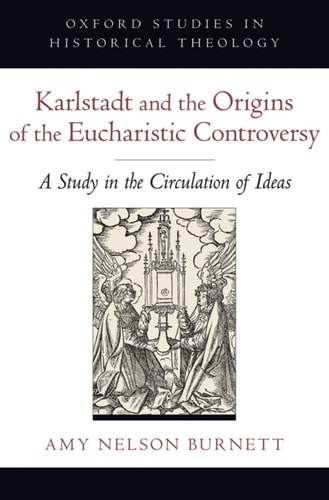
Karlstadt and the Origins of the Eucharistic Controversy: A Study in the Circulation of Ideas
0
0
As an Amazon Associate and affiliate partner, Menrva Books earns from qualifying purchases. Learn more
Author Description
The debate over the Lord's Supper had momentous consequences for the Reformation, causing the division of the evangelical movement, influencing the formation of political alliances, and contributing to cultural differences among the Protestant territories of Germany and Switzerland. Karlstadt and the Origins of the Eucharistic Controversy is the first full-length study of the beginning of that debate. Going beyond the traditional focus on Martin Luther and Ulrich Zwingli, it emphasizes the diversity of the "sacramentarian" challenge to traditional belief in Christ's corporeal presence in the bread and wine of the Eucharist, and it re-evaluates the significance of Luther's colleague, Andreas Bodenstein von Karlstadt, for the debate. Burnett describes Luther's earliest criticisms of the mass and the efforts in Wittenberg to reform liturgical praxis to correspond with his ideas. She then looks at pamphlets written by other reformers to show how Luther's understanding of the sacrament was adapted and modified outside of Wittenberg. Ultimately, Burnett shows how Karlstadt's eucharistic pamphlets introduced into the public debate arguments that would become standard Reformed criticisms of the Lutheran position. The book also demonstrates the influence not only of Erasmus but also of John Wyclif and the Hussites for discussions of the sacrament, highlights the role of the reformers of Basel and Strasbourg for developing the "Zwinglian" understanding of the Lord's Supper, and draws attention to the early eucharistic theology of the Silesians Kaspar Schwenckfeld and Valentin Krautwald. This book will be an indispensable guide for readers seeking to understand the issues surrounding the outbreak of the eucharistic controversy in the sixteenth century.
Menrva's Summary
THE THESIS
This study investigates the origins of the sixteenth-century eucharistic controversy, specifically examining how the debate over the Lord's Supper fractured the early Reformation movement. Amy Nelson Burnett, a scholar of Reformation history, utilizes a wide array of contemporary pamphlets and theological treatises to argue that the conflict was far more complex than the traditional Luther-Zwingli binary suggests. By centering the contributions of Andreas Bodenstein von Karlstadt and other lesser-known reformers, the author demonstrates how diverse intellectual influences, including Wyclif and the Hussites, shaped the development of Reformed eucharistic theology.
THE SCOPE MAP
What You Will Find
- An analysis of the early liturgical reforms in Wittenberg.
- A detailed examination of the circulation of eucharistic pamphlets across Germany and Switzerland.
- An evaluation of the influence of Erasmus, John Wyclif, and the Hussites on sacramental discourse.
- A study of the theological contributions of Kaspar Schwenckfeld and Valentin Krautwald.
Scope Limits
- The book does not provide a comprehensive history of the entire Reformation period.
- It does not focus on the later political consequences of the controversy beyond the initial formation of alliances.
THE AUTHORITY PERSPECTIVE
Scholars and historians recognize this work as a foundational text for understanding the intellectual diversity of the early Reformation. Readers frequently note the academic density of the prose and the meticulous archival research that characterizes Burnett's analysis of sixteenth-century theological debates.
Page Count:
252
Publication Date:
2011-01-01
Publisher:
Oxford University Press
ISBN-10:
0190454091
ISBN-13:
9780190454098
History
Religion
Theology
European History
Christian History
Reformation
Community Tags
Similar Books