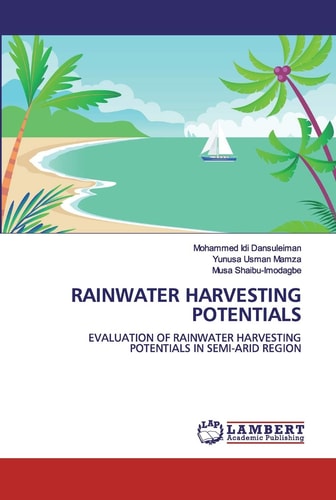
Evaluation of Rainwater Harvesting Potentials in Semi-Arid Region
0
0
As an Amazon Associate and affiliate partner, Menrva Books earns from qualifying purchases. Learn more
Author Description
Access to potable water (quantity and quality) is inadequate worldwide. Rainwater harvest as source of water supply in a selected housing estate (1000-housing estate) in Maiduguri, Nigeria was evaluated. The estate was selected based on it location, types of flats and average number of person per flat was recorded. Water demand of 120 l per capita per day (based on WHO standard) was used to compute water demand per flat in the estate. Rainfall data in the estate were collected (1979-2013) from Nigerian Meteorological Agency (NIMET). The effective surface areas of various flats (1-bedroom 2-bedrooms, 3-bedrooms and 4-bedrooms) were calculated using standard method. Water yield per flats were calculated using rainfall intensity and effective surface area (Rational method). The water yields (Rain harvest) per flats were used in design, collection transportation and storage facilities for the flats. First and last rains were collected from various roofs types using standard procedures for laboratory analyzed to ascertain the water quality and selected water quality parameters (physical and chemical) were measured using standard procedures.
Menrva's Summary
THE THESIS
This study evaluates the potential of rainwater harvesting as a water supply source in a semi-arid region of Nigeria. The research focuses on a selected housing estate in Maiduguri, Nigeria, assessing water demand against available rainfall data from 1979 to 2013. It details the calculation of water demand per flat based on WHO standards and the computation of water yield per flat using rainfall intensity and effective roof surface areas via the Rational method. The study also includes the design of collection, transportation, and storage facilities, alongside laboratory analysis of collected rainwater to determine its physical and chemical quality.
THE SCOPE MAP
- Assessment of potable water inadequacy in semi-arid regions.
- Evaluation of rainwater harvesting potential in a selected housing estate (1000-housing estate) in Maiduguri, Nigeria.
- Calculation of water demand per flat based on WHO standards (120 l per capita per day).
- Utilization of rainfall data from 1979-2013 provided by the Nigerian Meteorological Agency (NIMET).
- Determination of effective surface areas for various flat types (1-bedroom, 2-bedrooms, 3-bedrooms, 4-bedrooms).
- Application of the Rational method to calculate water yield per flat using rainfall intensity and effective surface area.
- Design considerations for rainwater collection, transportation, and storage facilities.
- Laboratory analysis of first and last rains to ascertain physical and chemical water quality parameters.
THE AUTHORITY PERSPECTIVE
The study provides a detailed technical evaluation of rainwater harvesting feasibility in a specific urban context within a semi-arid climate. Its methodology, which includes demand calculation, yield estimation using the Rational method, and water quality analysis, suggests a practical approach to addressing water scarcity. The inclusion of data from a significant historical period (1979-2013) and adherence to WHO standards lend credibility to its findings. The work is likely to be of interest to urban planners, environmental engineers, and policymakers concerned with sustainable water resource management in similar regions.
Page Count:
160
Publication Date:
2019-01-01
Publisher:
KS Omniscriptum Publishing
ISBN-10:
3659565539
ISBN-13:
9783659565533
Non-Fiction
Science
urban planning
Nigeria
Community Tags
Similar Books