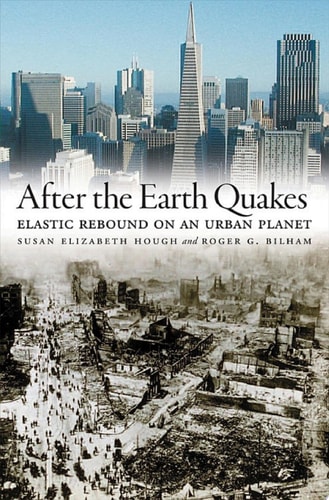
After the Earth Quakes: Elastic Rebound on an Urban Planet
0
0
As an Amazon Associate and affiliate partner, Menrva Books earns from qualifying purchases. Learn more
Author Description
Earthquakes rank among the most terrifying natural disasters faced by mankind. Out of a clear blue sky-or worse, a jet black one-comes shaking strong enough to hurl furniture across the room, human bodies out of bed, and entire houses off of their foundations. When the dust settles, the immediate aftermath of an earthquake in an urbanized society can be profound. Phone and water supplies can be disrupted for days, fires erupt, and even a small number of overpass collapses can snarl traffic for months. However, when one examines the collective responses of developed societies to major earthquake disasters in recent historic times, a somewhat surprising theme emerges: not only determination, but resilience; not only resilience, but acceptance; not only acceptance, but astonishingly, humor. Elastic rebound is one of the most basic tenets of modern earthquake science, the term that scientists use to describe the build-up and release of energy along faults. It is also the best metaphor for societal responses to major earthquakes in recent historic times. After The Earth Quakes focuses on this theme, using a number of pivotal and intriguing historic earthquakes as illustration. The book concludes with a consideration of projected future losses on an increasingly urbanized planet, including the near-certainty that a future earthquake will someday claim over a million lives. This grim prediction impels us to take steps to mitigate earthquake risk, the innately human capacity for rebound notwithstanding.
Menrva's Summary
THE THESIS
This book investigates the intersection of geophysical earthquake mechanics and the resilience of human societies in the face of urban catastrophe. Authors Roger G. Bilham and Susan Elizabeth Hough, both established geophysicists, utilize the scientific principle of elastic rebound as a conceptual framework to analyze how modern civilizations recover from seismic events. They argue that while societies possess an inherent capacity for rebound, the increasing density of urban environments necessitates proactive risk mitigation to prevent future mass-casualty events.
THE SCOPE MAP
What You Will Find
- Analysis of historical earthquake events and their immediate societal impacts
- Application of the elastic rebound theory to human behavioral responses
- Projections regarding future seismic risks in rapidly urbanizing regions
- Examination of infrastructure vulnerabilities including water, power, and transportation
Scope Limits
- Does not provide a comprehensive technical manual for structural engineering
- Does not focus on individual survival techniques for private citizens
THE AUTHORITY PERSPECTIVE
Experts recognize this work as a significant synthesis of seismology and social science, noting its accessible approach to complex geophysical phenomena. Readers frequently highlight the authors' ability to balance technical scientific explanations with a sobering analysis of urban vulnerability.
Page Count:
329
Publication Date:
2005-01-01
Publisher:
Oxford University Press
ISBN-10:
0190292520
ISBN-13:
9780190292522
Science
History
Geology
Earth Sciences
Geophysics
urban planning
Earth Science
Earthquakes
Sociology
Community Tags
Similar Books