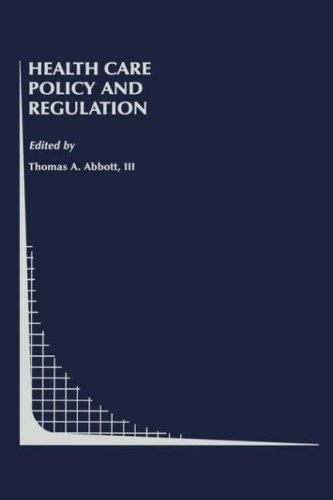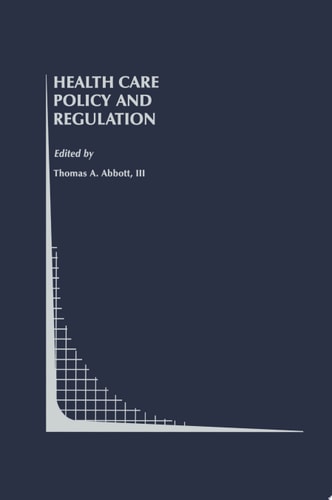
Health Care Policy and Regulation
0
0
As an Amazon Associate and affiliate partner, Menrva Books earns from qualifying purchases. Learn more
Author Description
5 care reforms. Part II: Price Regulation The second partofthis volume examines the role ofprice regulation in controlling health care costs. It contains three chapters. In chapter seven, I examine the alternatives for regulating pharmaceutical prices. In chapter eight, Jack Hadley examines the impactofvarious forms ofhospital price regulation; while in chapter nine,MarkPaulyexaminestheroleofpriceregulation incontrollingphysician fees. Chapter seven focuses on the issue of regulating pharmaceutical prices. There are two key issues examined in this paper. First, is there a clear need for price regulation, and second, can price regulation work in this industry? In response to the first question, I come to the conclusion that the proponents ofprice regulation have not really proven their case. Although the financial returns in the pharmaceu tical industry have been slightly higher than expected during the 1970s and 1980s, there is not overwhelming evidence of"price gouging" or excessive profits on the part of the industry. In response to the second question, the answer is clearly no. The traditional approaches to price regulation will not have the intended affect of eliminating excess profits from the industry while maintaining the incentives for research and development. First, rate-of-return regulation, the most natural approach, would result in many adverse incentives-includingexcessive investment in research and developmentinorderto inflatetheratebaseused tocalculatedtheallowablereturns.
Menrva's Summary
THE THESIS
This volume investigates the complex landscape of health care policy and regulation, focusing on strategies to control escalating costs. It delves into five key areas of reform, with a significant portion dedicated to price regulation. The analysis critically examines the effectiveness and potential drawbacks of various regulatory approaches, particularly in the pharmaceutical, hospital, and physician fee sectors, questioning the necessity and feasibility of traditional price controls.
THE SCOPE MAP
- Analysis of five distinct health care reform strategies.
- Examination of pharmaceutical price regulation, including the need and efficacy of such controls.
- Discussion of alternatives for regulating pharmaceutical prices.
- Impact assessment of various forms of hospital price regulation.
- Exploration of the role of price regulation in controlling physician fees.
- Critique of traditional price regulation approaches and their potential adverse incentives.
- Consideration of the balance between price regulation and maintaining incentives for research and development.
THE AUTHORITY PERSPECTIVE
This work appears to offer a detailed economic analysis of health care cost containment strategies, with a particular focus on price regulation. The author's critical stance on the efficacy of traditional regulatory methods suggests a nuanced and potentially contrarian viewpoint. The inclusion of contributions from other experts like Jack Hadley and Mark Pauly indicates a comprehensive scope within its specialized domain. The text likely appeals to policymakers, economists, and healthcare administrators seeking in-depth analysis of regulatory frameworks.
Page Count:
261
Publication Date:
2012-12-06
Publisher:
Springer Science & Business Media
ISBN-10:
1461522196
ISBN-13:
9781461522195
Health
Economics
Non-Fiction
Regulation
Health Policy
Community Tags
Other Editions(3)
Similar Books