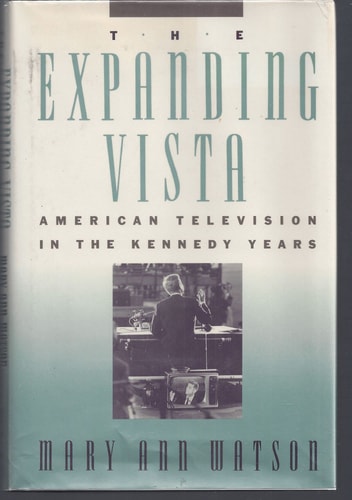
The Expanding Vista: American Television in the Kennedy Years
0
0
As an Amazon Associate and affiliate partner, Menrva Books earns from qualifying purchases. Learn more
Author Description
The Kennedy era began with a groundbreaking moment in television--a debate between the presidential candidates, one that left little doubt about who was attuned to the new medium: Kennedy looking sharp and calm in dark blue; and Nixon fading into the set in his grey suit, looking nervous, sweating. And it ended with another kind of television landmark: a traumatized populace--still trying to comprehend the unthinkable death of its President--united electronically in a national ritual of mourning. In the Kennedy years, television not only recorded history, it made history.The Expanding Vista offers an engaging and insightful look at American television in the Kennedy years. Mary Ann Watson demonstrates how television was woven into the events and policies of John Kennedy's presidency, not only in his unprecedented use of the medium in campaigning and image projection, but in the vigorous efforts of his administration to regulate and improve the content of network programs. She shows Kennedy making himself accessible to the public by appearing on the Tonight Show as a candidate in 1960, allowing documentary cameras to follow him in the Oval Office, and supporting Jacqueline's televised tour of the renovated White House. She examines FCC Chairman Newton Minow's campaign to uplift network programs (including his famous Vast Wasteland speech), and the outstanding documentaries, controversial dramas, and other innovative offerings that followed. In addition, The Expanding Vista offers an inside look at television's role in the epic events of these years, from the civil rights struggle, to the space race, to the Cuban Missile Crisis--when Kennedy broke diplomatic tradition by announcing on television that nuclear weapons were in Cuba, and when the Soviets transmitted their offer for a compromise through a television reporter. And Watson expores how television in the 1960s emerged as the medium we know today, from the new technology (including videotape and the first commun
Menrva's Summary
THE THESIS
How did the emergence of television as a dominant cultural and political force during the Kennedy administration fundamentally alter the relationship between the American public and its government? Mary Ann Watson, a scholar of media history, utilizes archival research and historical analysis to examine the intersection of broadcasting and policy. She argues that the Kennedy era served as a crucible for modern media, where the medium transitioned from a simple recording device to an active participant in political strategy, regulation, and national identity formation.
THE SCOPE MAP
What You Will Find
- Analysis of the 1960 presidential debates and their impact on political image-making.
- Examination of FCC regulatory efforts, including Newton Minow's critique of network programming.
- Case studies on the role of television during the Cuban Missile Crisis and the Civil Rights Movement.
- Documentation of the technological evolution of broadcasting, including the introduction of videotape and satellite communication.
THE AUTHORITY PERSPECTIVE
Experts recognize this work as a foundational text for understanding the symbiotic evolution of television and American politics in the early 1960s. Scholars frequently cite Watson's research for its balanced approach to both the regulatory history of the FCC and the cultural impact of televised national events.
Page Count:
304
Publication Date:
1990-10-25
Publisher:
Oxford University Press
ISBN-10:
0195057465
ISBN-13:
9780195057461
History
American History
Television broadcasting
Media Studies
Television history
Community Tags
Similar Books