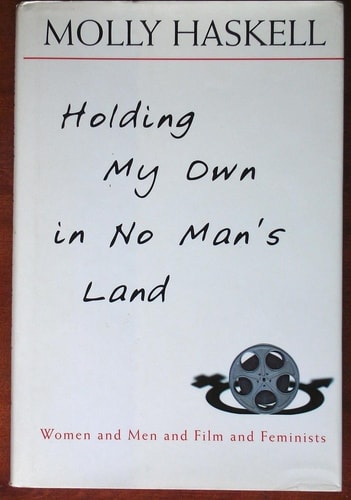
Holding My Own in No Man's Land: Women and Men and Film and Feminists
0
0
As an Amazon Associate and affiliate partner, Menrva Books earns from qualifying purchases. Learn more
Author Description
Molly Haskell, one of America's leading film critics, has been delighting readers for decades with her intelligence and insight. Her landmark book, From Reverence to Rape: The Treatment of Women in the Movies, praised for its "wit and style" and called "a valuable contribution to film scholarship," is still considered among the most stimulating and important books on the subject of women and film. In Holding My Own in No Man's Land, a series of pieces written in the twenty years since the publication of From Reverence to Rape, Haskell once again explores the relationship between women and men, and between the movies and those who watch them.Haskell remains a controversial figure in both feminist and film circles, accused of "uncritically celebrating heterosexual romance"--a charge to which Haskell cheerfully pleads guilty. Holding My Own In No Man's Land challenges the conventional feminist wisdom that the classic films of the Thirties, Forties, and Fifties were made by a male-dominated industry which reduced women to objects of the "male gaze." Instead, she says that women were better served by the notoriously tyrannical studio system than they are in the "newer, freer, hipper Hollywood of the present." A fascinating interview with Doris Day points out that, despite her current image as a symbol of all that was repressive about the suburban Fifties, she played a series of roles as--and was herself--a successful career woman who worked because she enjoyed it. In another perceptive portrait, Haskell describes the mesmerizing power the sultry, self-parodying sex symbol Mae West had on screen, and the financial clout she had off screen. And she writes about Howard Hawks's screwball comedies, such as His Girl Friday and Man's Favorite Sport from the Thirties, where assertive women were equal to men, and more than held their own in the battle of the sexes.Holding My Own in No Man's Land ranges from interviews with Hollywood legends such as Gloria Swanson and John Wayne,
Menrva's Summary
THE THESIS
Does the modern film industry provide a more equitable representation of women than the studio system of the mid-twentieth century? Molly Haskell, a prominent film critic, examines the evolution of gender roles in cinema by contrasting the classic era of Hollywood with contemporary filmmaking. She argues that the rigid studio system often allowed for more complex and assertive female characters than the supposedly liberated films of the modern era, challenging prevailing feminist critiques of the 'male gaze.'
THE SCOPE MAP
What You Will Find
- Analysis of gender dynamics in films from the 1930s through the 1950s.
- Critical evaluation of the studio system versus modern Hollywood production models.
- Interviews and profiles of iconic figures including Doris Day, Gloria Swanson, and John Wayne.
- Reassessment of screwball comedies and the portrayal of career-driven women in classic cinema.
THE AUTHORITY PERSPECTIVE
Critics and scholars recognize this collection as a provocative counter-narrative to standard feminist film theory. Readers frequently note that Haskell’s prose is accessible yet intellectually rigorous, making it a significant contribution to the study of gender in media.
Page Count:
216
Publication Date:
1997-01-30
Publisher:
Oxford University Press
ISBN-10:
0195053095
ISBN-13:
9780195053098
Cinema History
Gender Studies
Feminism
Film Criticism
Essays
Community Tags
Similar Books