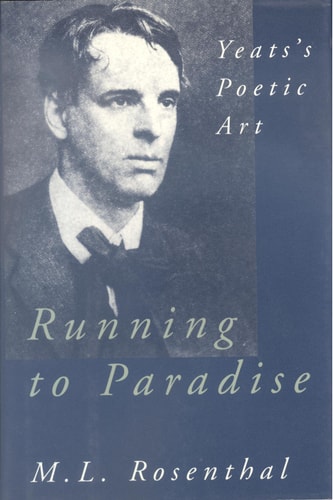
Running to Paradise: Yeats's Poetic Art
0
0
As an Amazon Associate and affiliate partner, Menrva Books earns from qualifying purchases. Learn more
Author Description
In Running to Paradise, M.L. Rosenthal, hailed by the Times Literary Supplement as "one of the most important critics of twentieth-century poetry," leads us through the lyric poetry and poetic drama of our century's greatest poet in English. His readings shed new, vivid light on Yeats's daring uses of tradition, his love poetry, and the way he faced the often tragic realities of revolution and civil war. Running to Paradise describes Yeat's whole effort--sometimes leavened by wild humor--to convey, with high poetic integrity, his passionate sense of his own life and of his chaotic era.Himself a noted poet, Rosenthal stresses Yeats's artistry and psychological candor. The book ranges from his early exquisite lyrical poems and folklore-rooted plays, through the tougher-minded, more confessional mature work (including the sublime achievement of The Tower), and then to the sometimes "mad" yet often brilliant tragic or comic writing of his last years. Quoting extensively from Yeats, Rosenthal charts the gathering force with which the poet confronted his major life-issues: his art's demands, his persistent but hopeless love for one woman, the complexities of marriage to another woman at age 52, and his distress during Ireland's "Troubles." Yeats's deep absorption in female sensibility, in the cycles of history and human thought, and in supernaturalism and "the dead" comes strongly into play as well.
Menrva's Summary
THE THESIS
This work investigates the evolution of W.B. Yeats's poetic art, examining how his personal experiences and the political instability of Ireland shaped his creative output. M.L. Rosenthal, a distinguished critic and poet, utilizes a comprehensive analysis of Yeats's lyric poetry and drama to argue that the poet's work reflects a profound psychological candor. By synthesizing biographical details with close readings of the texts, Rosenthal provides a framework for understanding Yeats's transition from folklore-inspired early works to the complex, confessional nature of his mature writing.
THE SCOPE MAP
What You Will Find
- Analysis of Yeats's lyric poetry and poetic drama spanning his entire career.
- Examination of the poet's engagement with Irish history, including the Troubles and civil war.
- Exploration of thematic concerns such as supernaturalism, female sensibility, and historical cycles.
- Critical assessment of major collections including The Tower and later works.
THE AUTHORITY PERSPECTIVE
Critics and scholars recognize this text as a significant contribution to the study of twentieth-century poetry due to Rosenthal's dual perspective as both a critic and a poet. Readers frequently note the clarity with which the author navigates the dense, often esoteric themes present in Yeats's later, more experimental writing.
Page Count:
384
Publication Date:
1994-01-06
Publisher:
Oxford University Press
ISBN-10:
0195052005
ISBN-13:
9780195052008
Poetry
Biography
Literary Analysis
Irish literature
Literary Criticism
Community Tags
Similar Books