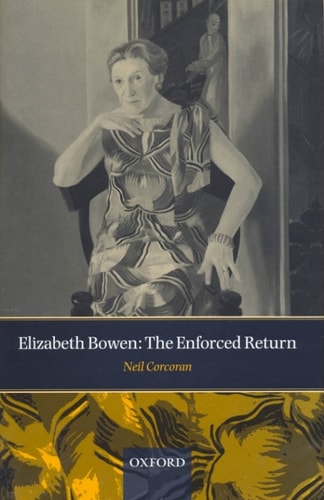
Elizabeth Bowen: The Enforced Return
0
0
As an Amazon Associate and affiliate partner, Menrva Books earns from qualifying purchases. Learn more
Author Description
Elizabeth Bowen is a writer who is still too little appreciated. Neil Corcoran presents here a critical study of her novels, short stories, family history, and essays, and shows that her work both inherits from the Modernist movement and transforms its experimental traditions. Elizabeth Bowen: The Enforced Return explores how she adapts Irish Protestant Gothic as a means of interpreting Irish experience during the Troubles of the 1920s and the Second World War, and also as a way of defining the defencelessness of those enduring the Blitz in wartime London. She employs versions of the Jamesian child as a way of offering a critique of the treatment of children in the European novel of adultery, and indeed, implicitly, of the Jamesian child itself. Corcoran relates the various kinds of return and reflex in her work-notably the presence of the supernatural, but also the sense of being haunted by reading-to both the Freudian concept of the 'return of the repressed' and to T. S. Eliot's conception of the auditory imagination as a 'return to the origin'. Making greater interpretative use of extra-fictional materials than previous Bowen critics (notably her wartime reports from neutral Ireland to Churchill's government and the diaries of her wartime lover, the Canadian diplomat Charles Ritchie), Corcoran reveals how her fiction merges personal story with public history. Employing a wealth of original research, his radical new readings propose that Bowen is as important as Samuel Beckett to twentieth-century literary studies--a writer who returns us anew to the histories of both her time and ours.
Menrva's Summary
THE THESIS
This study investigates how Elizabeth Bowen’s literary corpus functions as a bridge between Modernist experimentalism and the historical realities of twentieth-century conflict. Neil Corcoran, a scholar of modern literature, utilizes a framework that synthesizes Bowen’s novels, short stories, and personal archives to argue for her central importance in the canon. By examining her adaptation of the Irish Protestant Gothic and her engagement with wartime trauma, the author positions Bowen as a peer to Samuel Beckett in her capacity to merge personal narrative with public history.
THE SCOPE MAP
What You Will Find
- Analysis of Bowen’s novels, short stories, and essays within the context of the Modernist movement.
- Examination of the 'Jamesian child' motif as a critique of European literary traditions.
- Integration of primary source materials, including wartime reports to the British government and private diaries of Charles Ritchie.
Scope Limits
- The text focuses primarily on literary and historical analysis rather than providing a comprehensive chronological biography.
- The study does not cover Bowen’s later career or post-war works with the same depth as her wartime and mid-century output.
THE AUTHORITY PERSPECTIVE
Scholars and critics recognize this work as a significant contribution to Bowen studies, particularly for its innovative use of extra-fictional materials to illuminate her creative process. Readers frequently note the academic density of the prose, which is intended for those already familiar with the intricacies of Modernist literary theory and Irish history.
Page Count:
218
Publication Date:
2004-01-01
Publisher:
Oxford University Press
ISBN-10:
019151859X
ISBN-13:
9780191518591
Biography
Irish literature
Literary Criticism
Literary History
English
Modernist
English & College Success
Community Tags
Similar Books