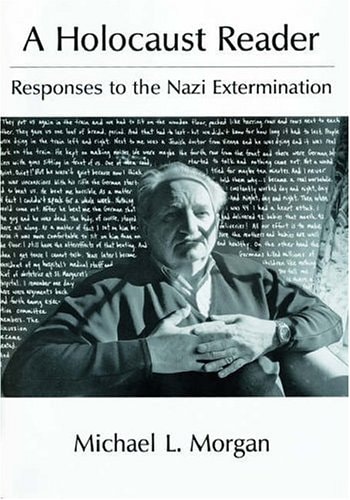
A Holocaust Reader: Responses to the Nazi Extermination
0
0
As an Amazon Associate and affiliate partner, Menrva Books earns from qualifying purchases. Learn more
Author Description
A Holocaust Reader: Responses to the Nazi Extermination features writings by theologians, literary figures, cultural critics, philosophers, political theorists, and others. It surveys the major themes raised by the Holocaust and examines the most provocative and influential responses to these topics and to the Holocaust itself. Organized in a roughly chronological pattern, the volume opens with early responses from the postwar period. Subsequent sections cover the emergence of central theological statements in the late 1960s and 1970s, the development of post-Holocaust thinking in the 1970s and 1980s, and burgeoning reflections on the significance of the death camps. Connections between the Holocaust and important events and episodes in Western culture in the eighties and nineties are also discussed. A Holocaust Reader: Responses to the Nazi Extermination offers selections from Theodor W. Adorno, Jean Améry, Hannah Arendt, Omer Bartov, Eliezer Berkovits, Michael André Bernstein, Martin Buber, Arthur A. Cohen, A. Roy Eckardt, Emil L. Fackenheim, Saul Friedlander, Amos Funkenstein, Irving Greenberg, Andreas Huyssen, Hans Jonas, Berel Lang, Primo Levi, Johann Baptist Metz, Richard Rubenstein, Kenneth Seeskin, Franklin Sherman, David Tracy, Elie Wiesel, Robert E. Willis, and Michael Wyschogrod. Ideal for courses in the Holocaust, Jewish studies, and the philosophy of religion, this extensive collection will also be of interest to general readers and scholars.
Menrva's Summary
THE THESIS
This volume investigates the evolution of intellectual, theological, and cultural responses to the Holocaust from the immediate postwar period through the late twentieth century. Michael L. Morgan, a scholar of Jewish philosophy, compiles a diverse array of primary source writings to examine how thinkers have grappled with the moral, political, and existential implications of the Nazi extermination. The text provides a structured framework for understanding the shift from early witness accounts to later, more abstract reflections on the significance of the death camps in Western history.
THE SCOPE MAP
What You Will Find
- A chronological survey of Holocaust discourse spanning the postwar era to the 1990s.
- Primary source selections from influential figures including Hannah Arendt, Primo Levi, and Elie Wiesel.
- Thematic analysis of theological, literary, and political responses to genocide.
- Contextual introductions for each section that bridge the gap between historical events and philosophical inquiry.
THE AUTHORITY PERSPECTIVE
Experts identify this collection as a foundational resource for academic courses in Jewish studies and the philosophy of religion. Readers frequently note the breadth of the contributors and the utility of the chronological organization for tracking the development of post-Holocaust thought.
Page Count:
384
Publication Date:
2000-08-31
Publisher:
Oxford University Press
ISBN-10:
0195059573
ISBN-13:
9780195059571
Religion
History
Philosophy
Holocaust
Jewish Studies
Community Tags
Similar Books