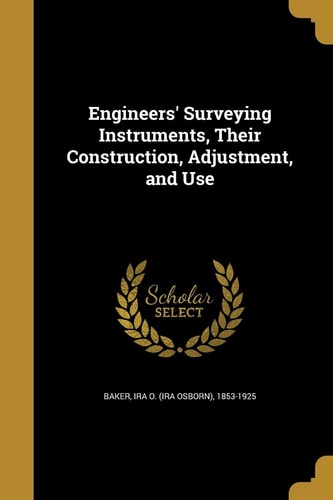
Engineers' Surveying Instruments, Their Construction, Adjustment, and Use
0
0
As an Amazon Associate and affiliate partner, Menrva Books earns from qualifying purchases. Learn more
Author Description
This work has been selected by scholars as being culturally important, and is part of the knowledge base of civilization as we know it. This work was reproduced from the original artifact, and remains as true to the original work as possible. Therefore, you will see the original copyright references, library stamps (as most of these works have been housed in our most important libraries around the world), and other notations in the work. This work is in the public domain in the United States of America, and possibly other nations. Within the United States, you may freely copy and distribute this work, as no entity (individual or corporate) has a copyright on the body of the work. As a reproduction of a historical artifact, this work may contain missing or blurred pages, poor pictures, errant marks, etc. Scholars believe, and we concur, that this work is important enough to be preserved, reproduced, and made generally available to the public. We appreciate your support of the preservation process, and thank you for being an important part of keeping this knowledge alive and relevant.
Menrva's Summary
THE THESIS
This work investigates the construction, adjustment, and practical application of surveying instruments used by engineers. Baker, an established scholar in the field, draws upon historical knowledge and technical understanding to present a comprehensive overview of these essential tools. The book aims to preserve and disseminate foundational knowledge about surveying equipment, ensuring its availability to future generations of engineers and historians of technology. It addresses the physical and mechanical principles underlying the design and function of these instruments.
THE SCOPE MAP
- Detailed descriptions of various surveying instruments.
- Instructions on the proper adjustment and calibration of these instruments.
- Guidance on the practical use of surveying equipment in engineering projects.
- Historical context of the development of surveying technology.
- Discussion of the mathematical and physical principles governing instrument operation.
- Explanation of common notations and potential imperfections inherent in historical texts.
THE AUTHORITY PERSPECTIVE
This book is presented as a significant historical artifact, selected for its cultural importance and contribution to the knowledge base of civilization. Its reproduction aims to preserve the original content as faithfully as possible, acknowledging the potential for imperfections due to its age and archival nature. Scholars recognize its value in maintaining the continuity of technical knowledge, making it available to the public through careful reproduction. The work is considered vital for understanding the evolution of engineering practices.
Page Count:
410
Publication Date:
2016-08-26
Publisher:
Creative Media Partners, LLC
ISBN-10:
1362165816
ISBN-13:
9781362165811
Non-Fiction
History
Surveying
Engineering
Community Tags
Similar Books