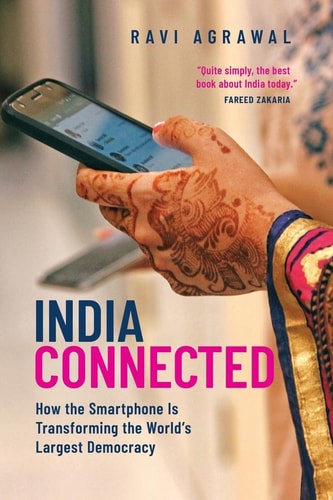
India Connected: How the Smartphone Is Transforming the World's Largest Democracy
0
0
As an Amazon Associate and affiliate partner, Menrva Books earns from qualifying purchases. Learn more
Author Description
India is connecting at a dizzying pace. In 2000, roughly 20 million Indians had access to the internet. In 2017, 465 million were online, with three new people logging on for the first time every second. By 2020, the country's online community is projected to exceed 700 million; more than a billion Indians are expected to be online by 2025. While users in Western countries progressed steadily over the years from dial-up connections on PCs, to broadband access, wireless, and now 4G data on phones, in India most have leapfrogged straight into the digital world with smartphones and affordable data plans.What effect is all this having on the ancient and traditionally rural culture dominated by family and local customs? Ravi Agrawal explores that very question, seeking out the nexuses of change and those swept up in them. Smartphones now influence arranged marriages, create an extension of one's social identity that moves beyond caste, bring within reach educational opportunities undreamed of a generation ago, bridge linguistic gaps, provide outlets and opportunities for start-ups, and are helping to move the entire Indian economy from cash- to credit-based. The effects are everywhere, and they are transformative.While they offer immediate access to so much for so many, smartphones are creating no utopia in a culture still struggling with poverty, illiteracy, corruption, gender inequality, and income disparity. Internet access has provided greater opportunities to women and altered how India's outcasts interact with the world; it has also made pornography readily available and provided an echo chamber for rumor and prejudice. Under a government determined to control content, it has created tensions. And in a climate of hypernationalism, it has fomented violence and even terrorism.The influence of smartphones on the world's largest democracy is pervasive and irreversible, disruptive and creative, unsettling and compelling. Agrawal's fascinating book gives us the people and places reflecting what the internet hath wrought. India Connected reveals both its staggering dimensions and implications, illuminating how it is affecting the progress of progress itself.
Menrva's Summary
THE THESIS
How does the rapid, widespread adoption of smartphone technology fundamentally reshape the social, economic, and political landscape of India? Ravi Agrawal, a journalist with extensive experience covering international affairs, utilizes a combination of on-the-ground reporting and socio-economic analysis to examine this digital transition. He argues that India's unique leapfrog into mobile-first internet access creates a complex duality, where technological empowerment exists alongside persistent systemic challenges like inequality and misinformation.
THE SCOPE MAP
What You Will Find
- Analysis of the shift from cash-based to credit-based economic systems.
- Examination of how mobile connectivity impacts traditional social structures like caste and arranged marriage.
- Case studies on the role of digital platforms in education, entrepreneurship, and political discourse.
- Investigation into the rise of hypernationalism and digital-fueled social tensions.
Scope Limits
- The text does not provide a comprehensive technical manual on mobile infrastructure development.
- It does not offer a predictive forecast of future government policy beyond current observations.
THE AUTHORITY PERSPECTIVE
Experts and readers frequently note the book's success in balancing macro-level economic trends with intimate, human-centric narratives. It is widely regarded as a clear-eyed examination of how technology interacts with deep-seated cultural traditions in a developing nation.
Page Count:
240
Publication Date:
2020-01-07
Publisher:
Oxford University Press
ISBN-10:
0190092122
ISBN-13:
9780190092122
Politics
Economics
History
Sociology
Rural
Human Interaction
Social Aspects
Reference
Engineering
Educational Resources
New Used & Rental Textbooks
Technology
Asia
India
Technology history
Community Tags
Similar Books






Reader Comments
Share Your Thoughts
No comments yet. Be the first to share your thoughts!