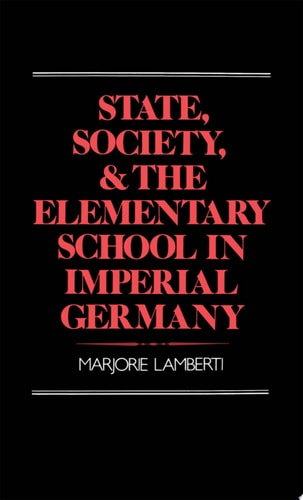
State, Society, and the Elementary School in Imperial Germany
0
0
As an Amazon Associate and affiliate partner, Menrva Books earns from qualifying purchases. Learn more
Author Description
The much admired school system of 19th-century Germany served as a model for the educational systems of many other countries, including Britain and the United States. In this illuminating study of German primary schools, Lamberti examines an educational tradition that was the object of wide emulation, but which was often misinterpreted by its admirers. Lamberti also explores the political significance of German educational policies in the Kulturkampf, in the suppression of Polish nationalism in the eastern provinces, and more generally in the struggle between the competing strands of liberalism and authoritarianism in the German state.
Menrva's Summary
THE THESIS
This study investigates the complex intersection of state policy, social control, and primary education within the German Empire to determine how schools functioned as instruments of political and cultural integration. Marjorie Lamberti, a scholar of modern German history, utilizes archival records and administrative documentation to challenge the idealized perception of the 19th-century German school system. She argues that these institutions were not merely neutral centers of learning but were active sites of political maneuvering, used to enforce state authority, manage religious conflicts, and suppress minority nationalist movements.
THE SCOPE MAP
What You Will Find
- Analysis of the educational policies during the Kulturkampf and their impact on primary schooling.
- Examination of the state's role in suppressing Polish nationalism through language and curriculum control in eastern provinces.
- Investigation into the ideological tension between liberal educational reform and authoritarian state mandates.
- Historical assessment of how the German school model was perceived and often misunderstood by international observers.
THE AUTHORITY PERSPECTIVE
Historians and educators recognize this work as a critical examination of the political dimensions of the Prussian and Imperial German educational apparatus. Scholars frequently cite Lamberti's research for its detailed analysis of how state-sponsored schooling served as a mechanism for social and political homogenization.
Page Count:
302
Publication Date:
1989-10-05
Publisher:
Oxford University Press
ISBN-10:
0195056116
ISBN-13:
9780195056112
History
Education Elementary
German history
Germany history
Education
European History
Education germany
Community Tags
Other Editions(3)

Similar Books