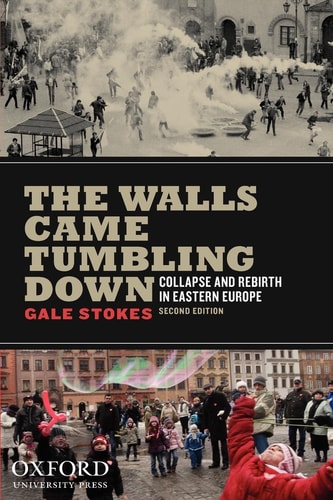
The Walls Came Tumbling Down: The Collapse of Communism in Eastern Europe
0
0
As an Amazon Associate and affiliate partner, Menrva Books earns from qualifying purchases. Learn more
Author Description
The revolutions of 1989 were as pivotal a moment in European history as 1917, 1848, or 1789--yet almost no one saw them coming until nearly the last moment: not Washington, Moscow, the Communist regimes, nor even the victorious rebels themselves. But as Gale Stokes shows in this powerful new history--the most comprehensive, analytical, and readable of its kind--momentum for change had been building since 1968, momentum which soon drove past Gorbachev-inspired reforms to outright revolution.In The Walls Came Tumbling Down, Stokes provides a compelling account of the Eastern European struggle for democracy, from the invasion of Czechoslovakia in 1968 through the most recent elections. Stokes vividly describes the thinkers, leaders, and events in each country, showing how the crushing of the Prague Spring had sparked the final disillusioment in Eastern Europe that culminated in the revolts of 1989. In Poland, workers struck again and again to force the government to negotiate, culminating in the creation of Solidarity. Solidarity, he writes, was skillfully led by Lech Walesa, who helped create a "self-limiting" revolution with largely apolitical demands. Under General Jeruzelski's martial law, it fostered a "parallel society" which proved so successful that Warsaw was forced to recognize the union. In Czechoslovakia, intellectuals turned to "anti-politics," forming Charter 77 to demand that the government abide by its own laws and agreements on civil rights. Stokes also explores the actions of rulers and governments, from Ceausescu's self-glorification to Hungary's official turn toward a more market-based economy. The author interweaves the fast-paced narrative with analytical insight, tracing the path of developments after Gorbachev lifted the lid on reform (showing, for instance, how East German reform crystalized after thousands fled across Hungary's newly-opened border to the West). Stokes provides deft biographical sketches of the key figures, from Polish Communis
Menrva's Summary
THE THESIS
This work investigates the underlying causes and rapid progression of the 1989 revolutions that dismantled Communist regimes across Eastern Europe. Gale Stokes, a historian specializing in Eastern European affairs, utilizes a blend of primary source analysis and political narrative to argue that the collapse was not an abrupt accident but the culmination of decades of systemic disillusionment and grassroots resistance starting with the 1968 Prague Spring. He examines the interplay between state-level policy shifts under Gorbachev and the localized, often spontaneous, movements for democratic reform.
THE SCOPE MAP
What You Will Find
- A detailed historical timeline spanning from the 1968 invasion of Czechoslovakia to the post-1989 democratic elections.
- Comparative analysis of resistance strategies, including the Polish Solidarity labor movement and the Czechoslovakian Charter 77 intellectual dissent.
- Biographical profiles of key political figures, including Lech Walesa, General Jaruzelski, and Nicolae Ceausescu.
- Examination of the geopolitical impact of the opening of the Hungarian border and the subsequent collapse of the East German regime.
THE AUTHORITY PERSPECTIVE
Experts frequently cite this text as a foundational, comprehensive account of the transition from Communist rule to democracy in Eastern Europe. Readers note that the prose balances academic rigor with an accessible narrative style suitable for both students and general history enthusiasts.
Page Count:
336
Publication Date:
1993-10-07
Publisher:
Oxford University Press
ISBN-10:
0195066448
ISBN-13:
9780195066449
History
Eastern Europe
Communism
European History
Cold War
Community Tags
Similar Books