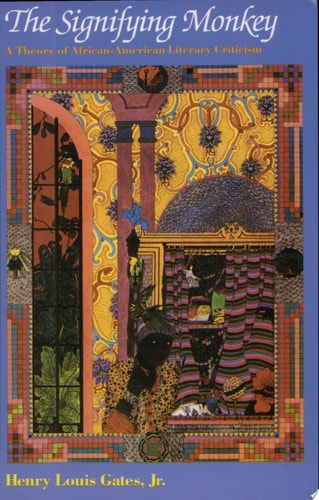
The Signifying Monkey: A Theory of African-American Literary Criticism
0
0
As an Amazon Associate and affiliate partner, Menrva Books earns from qualifying purchases. Learn more
Author Description
Henry Louis Gates, Jr.'s original, groundbreaking study explores the relationship between the African and African-American vernacular traditions and black literature, elaborating a new critical approach located within this tradition that allows the black voice to speak for itself.Examining the ancient poetry and myths found in African, Latin American, and Caribbean culture, and particularly the Yoruba trickster figure of Esu-Elegbara and the Signifying Monkey whose myths help articulate the black tradition's theory of its literature, Gates uncovers a unique system for interpretation and a powerful vernacular tradition that black slaves brought with them to the New World. His critical approach relies heavily on the Signifying Monkey--perhaps the most popular figure in African-American folklore--and signification and Signifyin(g).Exploring signification in black American life and literature by analyzing the transmission and revision of various signifying figures, Gates provides an extended analysis of what he calls the "Talking Book," a central trope in early slave narratives that virtually defines the tradition of black American letters. Gates uses this critical framework to examine several major works of African-American literature--including Zora Neale Hurston's Their Eyes Were Watching God, Ralph Ellison's Invisible Man, and Ishmael Reed's Mumbo Jumbo--revealing how these works signify on the black tradition and on each other.The second volume in an enterprising trilogy on African-American literature, The Signifying Monkey--which expands the arguments of Figures in Black--makes an important contribution to literary theory, African-American literature, folklore, and literary history.
Menrva's Summary
THE THESIS
Henry Louis Gates Jr. investigates how African-American literature functions as a distinct, self-referential tradition rooted in vernacular folklore and the trope of the Signifying Monkey. Drawing upon his extensive background in literary theory and African-American history, Gates constructs a critical framework that moves away from Western-centric analysis. He argues that black literature possesses an internal system of interpretation, defined by the act of 'Signifyin(g),' which allows authors to revise and respond to the works of their predecessors within a continuous cultural dialogue.
THE SCOPE MAP
What You Will Find
- Analysis of the Yoruba trickster figure Esu-Elegbara and the Signifying Monkey as foundational mythological archetypes.
- A detailed examination of the 'Talking Book' trope in early slave narratives.
- Comparative studies of major works by Zora Neale Hurston, Ralph Ellison, and Ishmael Reed.
- A theoretical methodology for interpreting African-American texts through their own linguistic and cultural vernacular.
THE AUTHORITY PERSPECTIVE
Scholars and critics widely recognize this text as a foundational work in the field of African-American literary theory. Readers frequently note the academic density of the prose, which requires a strong background in literary criticism to fully grasp the nuances of Gates's theoretical framework.
Page Count:
320
Publication Date:
1989-12-14
Publisher:
Oxford University Press
ISBN-10:
019506075X
ISBN-13:
9780195060751
African Americans
Literary Criticism
United States
Folklore
Literary theory
Oral Tradition
Community Tags
Similar Books