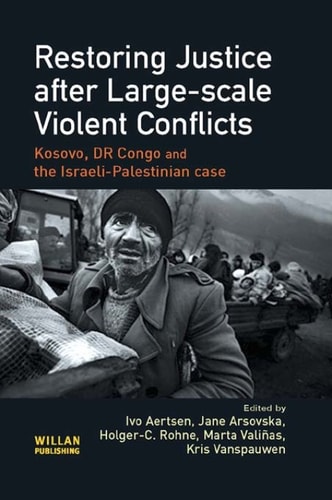
Restoring Justice after Large-scale Violent Conflicts
0
0
As an Amazon Associate and affiliate partner, Menrva Books earns from qualifying purchases. Learn more
Author Description
This book provides a comparative analysis of the potential of restorative justice approaches to dealing with mass victimization in the context of large-scale violent conflicts focusing on case studies from Kosovo, Israel-Palestine and Congo, incorporating contributions from leading authorities in these areas. One of the main objectives of the book is to examine if, how and to what extent restorative justice is applicable in various different cultural, social and historical contexts, and what common themes can be identified within the different regions under analysis. The book will also provide a critical analysis of the UN Basic Principles on the use of restorative justice programmes in criminal matters as applied to the context of large scale violence.
Menrva's Summary
THE THESIS
This book investigates the applicability and potential of restorative justice in the aftermath of large-scale violent conflicts. It offers a comparative analysis, focusing on case studies from Kosovo, Israel-Palestine, and Congo, and features contributions from leading experts in these regions. The core objective is to determine if, how, and to what extent restorative justice can be implemented across diverse cultural, social, and historical settings, identifying common themes. Additionally, it critically examines the UN Basic Principles on the use of restorative justice programmes in criminal matters as they pertain to contexts of mass violence.
THE SCOPE MAP
- Comparative analysis of restorative justice in post-conflict settings.
- Case studies from Kosovo, Israel-Palestine, and Congo.
- Examination of applicability across different cultural, social, and historical contexts.
- Identification of common themes in restorative justice application.
- Critical analysis of UN Basic Principles on restorative justice in mass violence contexts.
- Contributions from leading authorities in the field.
THE AUTHORITY PERSPECTIVE
The book is positioned as a significant contribution to the study of transitional justice, offering a nuanced exploration of restorative justice's role in complex post-conflict environments. Its comparative approach and focus on specific, challenging case studies suggest an in-depth analysis that will be valuable for academics and practitioners in fields such as criminology, international relations, and peace studies. The inclusion of expert voices from the regions under examination lends it considerable authority and practical relevance. The work likely aims to advance theoretical understanding while also informing policy and practice in addressing mass victimization.
Page Count:
512
Publication Date:
2013-05-13
Publisher:
Taylor & Francis
ISBN-10:
1134006306
ISBN-13:
9781134006304
Politics
Non-Fiction
History
Science
Nature
Criminology
Justice
International relations
Sociology
Conflict Resolution
Community Tags
Similar Books