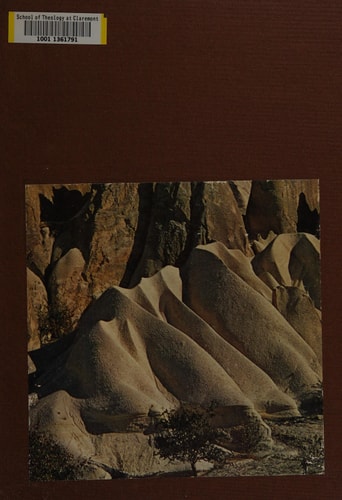
Caves of God: Cappadocia and its Churches
0
0
As an Amazon Associate and affiliate partner, Menrva Books earns from qualifying purchases. Learn more
Author Description
There exists perhaps no site more arresting than the strange rockscape of Cappadocia in central Turkey. Buried within the heart of this incredible vision of shapes and colors lie hundreds of monasteries and churches where Christian communities lived and prayed for the greater part of two millennia.This comprehensive study explores the land and hidden monuments of Christian Cappadocia. Spiro Kostof has written a readable, general introduction to the rockcut architecture of Cappadocia and its painted decoration and a critical review of the current state of scholarship on the subject. Focusing on the physical setting, the buildings, and painting programs in the context of their creation, he discusses the nature and historical background of monasticism in Cappadocia; depicts the builders, artists, and patrons who created the monuments; and describes the sources and meaning of the particular types of buildings and painting programs. This detailed account of the region and its monuments also includes revealing line drawings of plans, elevations, and cross sections, a glossary of terms, notes, a bibliography, and an index, as well as a new introduction for this edition.
Menrva's Summary
THE THESIS
This study investigates the historical, architectural, and artistic significance of the rock-cut churches and monastic complexes located in the Cappadocia region of Turkey. Spiro Kostof, an architectural historian, utilizes a combination of site analysis, historical documentation, and art historical inquiry to examine how these subterranean structures functioned within the context of early Christian communities. The text provides a framework for understanding the evolution of monastic life and the specific aesthetic programs that defined these hidden religious sites over two millennia.
THE SCOPE MAP
What You Will Find
- Analysis of rock-cut architectural techniques and structural design in Cappadocia.
- Examination of the historical background and development of monasticism in the region.
- Detailed study of the iconography and painting programs within the churches.
- Technical documentation including line drawings, site plans, elevations, and cross sections.
THE AUTHORITY PERSPECTIVE
Experts and scholars recognize this work as a foundational text for understanding the unique architectural heritage of Cappadocia. Readers frequently note the balance between accessible prose and the technical depth required to analyze these complex historical monuments.
Page Count:
350
Publication Date:
1989-08-03
Publisher:
Oxford University Press
ISBN-10:
0195060008
ISBN-13:
9780195060003
History
Religion
Architecture
Travel
Archaeology
Art History
Community Tags
Similar Books