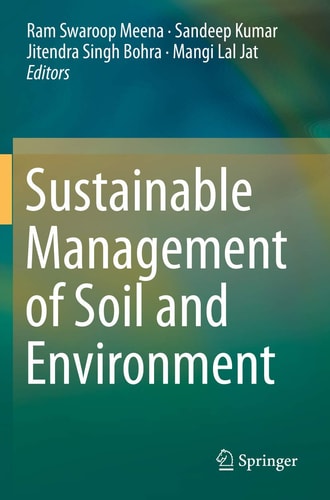
Sustainable Management of Soil and Environment
0
0
As an Amazon Associate and affiliate partner, Menrva Books earns from qualifying purchases. Learn more
Author Description
Fertilizers have been used extensively around the globe since the Green Revolution, due to the high subsidies. However, extensive fertilizer use exacerbates soil degradation and causes yield stagnation, and as a result threatens food security and soil sustainability, especially in developing countries. This means that sustainable soil and environmental management are vital to provide food and nutritional security for present and future generations. This has led to the International Union of Soil Science (IUSS) declaring 2015-2024 the International Decade of Soils. This book focuses on the impact of sustainable management of soil and environment on improving the functioning of soil-ecosystems and agronomic productivity, and also discusses food security, nutrient cycling, recent advances in INM technologies, eco-friendly cultivation, agricultural practices to reduce greenhouse gas (GHG) emissions, as well as conservation agriculture and its effects, and strategies for soil sustainability. Offering a comprehensive overview of management in the context of the sustainability of soil and the agroecosystems that it supports, it demonstrates the options available and provides insights into restoring soil health and matching soil nutrient supply with crop demand to ensure nutritional security in an eco-friendly environment.
Menrva's Summary
THE THESIS
The extensive and often subsidized use of fertilizers since the Green Revolution has led to soil degradation, yield stagnation, and threats to food security, necessitating a shift towards sustainable soil and environmental management. This book addresses the critical need for sustainable practices to ensure food and nutritional security for current and future generations, a cause championed by the International Union of Soil Science's declaration of 2015-2024 as the International Decade of Soils. It explores how sustainable management impacts soil ecosystem functioning and agronomic productivity, covering topics such as nutrient cycling, integrated nutrient management technologies, eco-friendly cultivation, and conservation agriculture. The work aims to provide a comprehensive overview of management options for restoring soil health and matching nutrient supply with crop demand in an eco-friendly manner.
THE SCOPE MAP
- The impact of sustainable management on soil ecosystem functioning and agronomic productivity.
- Strategies for ensuring food and nutritional security for present and future generations.
- Detailed discussion on nutrient cycling and recent advances in Integrated Nutrient Management (INM) technologies.
- Exploration of eco-friendly cultivation and agricultural practices designed to reduce greenhouse gas (GHG) emissions.
- Analysis of conservation agriculture and its effects on soil health.
- Methods and strategies for restoring soil health and matching soil nutrient supply with crop demand.
THE AUTHORITY PERSPECTIVE
The book is positioned as a vital resource for understanding and implementing sustainable soil and environmental management practices, particularly in the context of global food security challenges. It aims to provide a comprehensive overview of current knowledge and strategies, drawing attention to the importance of the International Decade of Soils. The content suggests a focus on practical applications and scientific advancements in agronomy and environmental science. The work is likely to be of interest to researchers, policymakers, and practitioners in agriculture and environmental management.
Page Count:
406
Publication Date:
2020-10-17
Publisher:
Springer Nature Singapore
ISBN-10:
9811388342
ISBN-13:
9789811388347
Non-Fiction
Science
Agronomy
Food security
Soil Science
Community Tags
Other Editions(3)
Similar Books



Reader Comments
Share Your Thoughts
No comments yet. Be the first to share your thoughts!