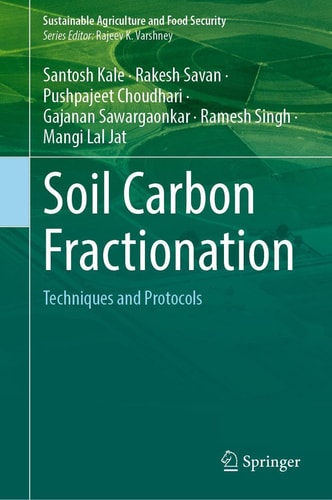
Soil Carbon Fractionation Techniques and Protocols
0
0
As an Amazon Associate and affiliate partner, Menrva Books earns from qualifying purchases. Learn more
Author Description
This textbook provides a thorough and systematic understanding of carbon fractions and the laboratory procedures for their estimation. It serves as both a practical lab manual and an educational guide, fostering knowledge dissemination and skill development in soil carbon research. It consolidates all procedures related to soil carbon fractionation, including active-, slow-, and passive-carbon pools into one document, with detailed methodologies. For complete and proper implementation, each method is provided with relevant chemical reactions, principles, and a step-by-step protocol in the form of flowcharts and calculations. This book is designed for streamlining the workflow for soil researchers and reducing preparation time. It promotes high-end carbon analyzers for sustainable, low-waste alternatives to traditional methods, aligning with modern environmental and agricultural resilience goals This book is exclusively for advanced graduate students and researchers working in the field of soil science and related disciplines.
Menrva's Summary
THE THESIS
This textbook systematically details the laboratory procedures for estimating soil carbon fractions and their associated pools. It is designed as a practical lab manual and educational guide for advanced graduate students and researchers in soil science, consolidating methodologies for active, slow, and passive carbon pools. The book provides detailed protocols, including chemical reactions, principles, and step-by-step flowcharts, to streamline workflow and reduce preparation time. It also advocates for modern, sustainable, low-waste carbon analysis techniques aligned with environmental resilience goals.
THE SCOPE MAP
- Detailed methodologies for soil carbon fractionation.
- Inclusion of active-, slow-, and passive-carbon pools.
- Explanation of relevant chemical reactions and principles for each method.
- Step-by-step protocols presented in flowcharts.
- Guidance on calculations for data analysis.
- Emphasis on streamlining workflow for soil researchers.
- Promotion of sustainable, low-waste carbon analyzers.
- Alignment with modern environmental and agricultural resilience goals.
THE AUTHORITY PERSPECTIVE
This book is intended for advanced graduate students and researchers in soil science, offering a comprehensive guide to soil carbon fractionation techniques. Its structured approach, combining theoretical principles with practical protocols, aims to enhance knowledge dissemination and skill development in the field. By consolidating diverse methodologies and promoting efficient, sustainable laboratory practices, it seeks to support modern environmental and agricultural resilience goals. The detailed step-by-step instructions and visual aids are designed to streamline research workflows and reduce preparation time for complex analyses.
Page Count:
96
Publication Date:
2026-01-15
Publisher:
Springer Nature Singapore
ISBN-10:
9819540674
ISBN-13:
9789819540679
Science
Non-Fiction
Laboratory manuals
Soil Science
Research Methods
Community Tags
Similar Books