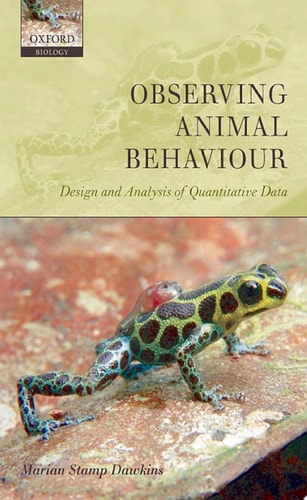
Observing Animal Behaviour: Design and Analysis of Quantitative Data
0
0
As an Amazon Associate and affiliate partner, Menrva Books earns from qualifying purchases. Learn more
Author Description
This book introduces the reader to the power of observation before, and sometimes instead of, experimental manipulation in the study of animal behaviour. It starts with simple and easily accessible methods suitable for student projects, before going on to demonstrate the possibilities that now exist for far more sophisticated analyses of observational data. At a time when animal welfare considerations are attracting political as well as scientific debate, the potential for non-intrusive studies on animals is being increasingly recognized. Observation emerges as a valuable alternative approach, often yielding highly informative results in situations (such as on zoos, farms or for wild animals) where more invasive experimental techniques would be undesirable, unethical or just plain impossible. However, to justify its place alongside experimentation as a rigorous scientific method, observation needs to be just as disciplined and systematic and have just as much attention paid to project design in the way that observations are made and recorded. Observing Animal Behaviour takes the reader through all these stages: from the initial observations, to the formulation of hypotheses, and their subsequent testing with further systematic observations. Although designed principally as a companion text for advanced undergraduate and students taking courses in animal behaviour, this accessible text will be essential reading for anyone wanting to study animal behaviour using observational methods rather than experimentation, and assumes no previous knowledge of animals, statistics or scientific method. It will be of particular relevance and use to those professional researchers and consultants in the behavioural sciences who seek a compact but comprehensive introduction to the quantitative observation of animal behaviour.
Menrva's Summary
THE THESIS
This book investigates how systematic observation can serve as a rigorous, non-intrusive alternative to experimental manipulation in the study of animal behavior. Marian Stamp Dawkins, a prominent ethologist, provides a structured framework for researchers to collect and analyze quantitative data without relying on invasive techniques. The text argues that observational studies, when designed with the same discipline as laboratory experiments, offer significant scientific value for studying animals in zoos, farms, or natural habitats.
THE SCOPE MAP
What You Will Find
- Methodologies for designing observational studies in animal behavior.
- Techniques for formulating hypotheses and testing them through systematic data collection.
- Guidance on transitioning from simple student-level projects to sophisticated quantitative analysis.
Scope Limits
- The text does not cover invasive experimental procedures or laboratory-based surgical manipulation.
- It does not provide advanced statistical software tutorials, focusing instead on the conceptual design of data collection.
THE AUTHORITY PERSPECTIVE
Experts and educators frequently cite this work as a foundational text for students and researchers seeking to implement non-invasive behavioral studies. Readers often note the clarity of the prose, which makes complex methodological concepts accessible to those without extensive prior training in statistics or scientific design.
Page Count:
165
Publication Date:
2007-01-01
Publisher:
OUP Oxford
ISBN-10:
0191037443
ISBN-13:
9780191037443
Science
Animal Welfare
Observations
Nature
Statistics
Research Methods
Zoology
Community Tags
Other Editions(2)

Similar Books







Reader Comments
Share Your Thoughts
No comments yet. Be the first to share your thoughts!