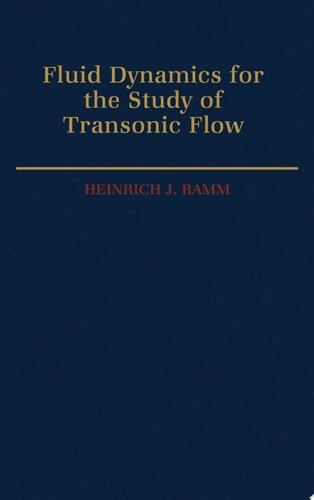
Fluid Dynamics for the Study of Transonic Flow
0
0
As an Amazon Associate and affiliate partner, Menrva Books earns from qualifying purchases. Learn more
Author Description
This new book leads readers step-by-step through the complexities encountered as moving objects approach and cross the sound barrier. The problems of transonic flight were apparent with the very first experimental flights of scale-model rockets when the disastrous impact of shock waves and flow separations caused the aircraft to spin wildly out of control. Today many of these problems have been overcome, and this book offers an introduction to the transonic theory that has made possible many of these advances. The emphasis is on the most important basic approaches to the solution of transonic problems. The book also includes explanations of common pitfalls that must be avoided. An effort has been made to derive the most important equations of inviscid and viscous transonic flow in sufficient detail so that even novices may feel confident in their problem-solving ability. The use of computer approaches is reviewed, with references to the extensive literature in this area, while the critical shortcomings of an exclusive reliance on computational methods are also described. The book will be valuable to anyone who needs to acquire an understanding of transonic flow, including practicing engineers as well as students of fluid mechanics.
Menrva's Summary
THE THESIS
This book investigates the fundamental physical principles and mathematical frameworks required to understand and solve the complex aerodynamic challenges associated with transonic flow. Heinrich J. Ramm, drawing upon established engineering science, provides a structured introduction to the behavior of fluids as objects approach the speed of sound. The text balances theoretical derivations of inviscid and viscous flow equations with practical guidance on avoiding common analytical pitfalls in aerospace design.
THE SCOPE MAP
What You Will Find
- Mathematical derivations for both inviscid and viscous transonic flow equations.
- Comparative analysis of analytical methods versus computational fluid dynamics approaches.
- Identification of common pitfalls and failure modes in transonic aerodynamic modeling.
- Foundational theory regarding shock waves and flow separation in high-speed flight.
THE AUTHORITY PERSPECTIVE
Experts and practitioners recognize this text as a reliable introduction for students and engineers entering the field of high-speed aerodynamics. Readers frequently note the clarity of the mathematical derivations, which serve to bridge the gap between theoretical fluid mechanics and practical engineering applications.
Page Count:
216
Publication Date:
1990-02-01
Publisher:
Oxford University Press
ISBN-10:
0195060970
ISBN-13:
9780195060973
Science
Engineering
Fluid dynamics
Physics
Aeronautics
Community Tags
Other Editions(3)


Similar Books