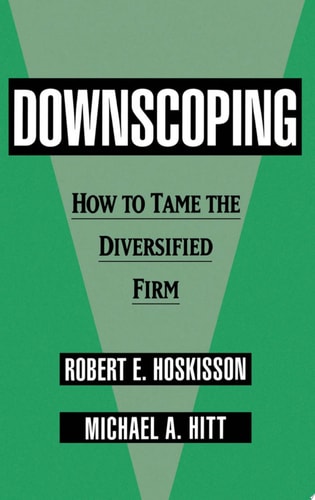
Downscoping: How to Tame the Diversified Firm
0
0
As an Amazon Associate and affiliate partner, Menrva Books earns from qualifying purchases. Learn more
Author Description
Large, diversified firms face unique challenges as they compete worldwide, and corporate restructuring is one way multinationals strive for competitive advantage. Weighing the pros and cons of a variety of approaches to restructuring, Downscoping offers executives a clear, strategic path through the maze.The authors show that when a multinational conglomerate fails to compete effectively, too much diversification may be the culprit. Whether the result of weak corporate governance or poor corporate strategy, over-diversification can make managers, unfamiliar with some of the markets in which they compete, opt for safety over innovation. This risk-aversion and lack of long-range commitment to innovation lead inevitably to stagnation over the longer term.The answer is not downsizing--closing offices and laying off personnel--but downscoping: a strategic approach to restructuring. The options include incentive and compensation adjustments for executives, leveraged buy-outs and capital structure changes, focusing on core skills, diversifying internationally while focusing on businesses in which a firm has strong competencies, and buying and selling mature businesses where product development is not a great concern. Regardless of the approach, executives must exercise strategic leadership during and after restructuring, including providing strategic direction, exploiting core competencies, developing human capital, and sustaining the corporate culture.Based on systematic research rather than casual observation, Downscoping provides a strong description of restructuring alternatives and their resulting tradeoffs. Its specific guidelines for maintaining competitiveness will be essential reading for managers involved in corporate restructuring.
Menrva's Summary
THE THESIS
This book investigates the strategic necessity of downscoping as a remedy for the inefficiencies inherent in over-diversified multinational corporations. Authors Michael A. Hitt and Robert E. Hoskisson utilize their extensive academic backgrounds in strategic management to analyze why conglomerates often struggle with stagnation. They argue that excessive diversification frequently stems from weak governance or risk-averse leadership, proposing a framework that prioritizes core competencies over indiscriminate expansion. By contrasting downscoping with simple downsizing, the text provides a roadmap for executives to restore long-term innovation and competitive advantage.
THE SCOPE MAP
What You Will Find
- Analysis of corporate restructuring alternatives including leveraged buy-outs and capital structure adjustments.
- Methodologies for aligning executive compensation with long-term strategic goals.
- Empirical research data comparing diversified firm performance against focused business models.
- Strategic leadership frameworks for managing human capital and corporate culture during transitions.
THE AUTHORITY PERSPECTIVE
Experts recognize this work as a rigorous, research-based examination of corporate restructuring that moves beyond superficial management trends. Readers frequently note the academic density of the prose, which makes it a foundational text for business students and senior executives navigating complex organizational change.
Page Count:
224
Publication Date:
1994-09-01
Publisher:
Oxford University Press
ISBN-10:
0195078438
ISBN-13:
9780195078435
Economics
Business
Finance
Corporate Strategy
Competition
Management
Community Tags
Similar Books