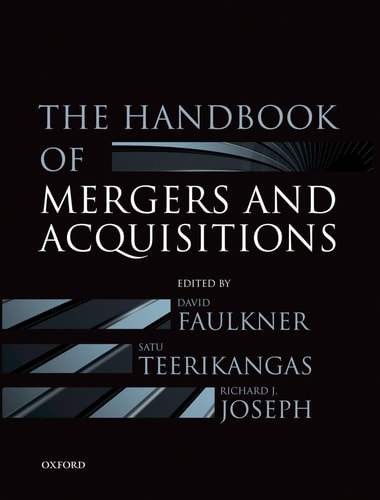
The Handbook of Mergers and Acquisitions
0
0
As an Amazon Associate and affiliate partner, Menrva Books earns from qualifying purchases. Learn more
Author Description
With its inception at the end of the nineteenth century as a means of consolidation and reorganization, mergers and acquisitions (M&A) have since become quasi-institutionalized as one of the primary strategic options for organizations, as they seek to secure their position in an ever more competitive and globalizing market place. Despite the optimism surrounding M&A as strategic moves, research on post-merger company performance suggests that most firms engaging in M&A activity do not achieve the sought-after performance targets, either immediately or in the years following the deal. What is it that drives M&A activity when research results do not support the performance expectations of these undertakings? Alternatively, have M&A scholars got it all wrong in the way that M&A performance is measured? Is the topic too complex, enduring, and multifaceted to study?The handbook argues that the field of M&A is in need of a re-rooting: past research needs to be critically reviewed, and fundamental assumptions revisited. A key issue preventing efforts in the practice and study of M&A from achieving dynamic syntheses has been the disciplinary gulf separating strategy, finance, and human relations schools. The handbook aims to bridge the hitherto separate disciplines engaged in the study and practice of M&A to provide more meaningful results.To this end, the handbook brings together a set of prominent and emerging scholars and practitioners engaged in the study of M&A to provide thought-provoking, state of the art overviews of M&A through four specific "lenses"--strategic, financial, socio-cultural, and sectoral approaches. By summarizing key findings in current research and exploring ways in which the differing approaches could and should be "synthesized," it aims to highlight the key issues facing M&A practitioners and academics at the dawn of the third millennium.
Menrva's Summary
THE THESIS
This handbook investigates why mergers and acquisitions remain a primary strategic tool for organizations despite persistent research indicating that most deals fail to meet performance expectations. The authors, a team of prominent scholars and practitioners, argue that the field suffers from a disciplinary divide between strategy, finance, and human relations. By re-examining fundamental assumptions and bridging these disparate academic silos, the text provides a framework for a more integrated and accurate understanding of corporate consolidation.
THE SCOPE MAP
What You Will Find
- A comprehensive analysis of M&A through four distinct lenses: strategic, financial, socio-cultural, and sectoral.
- Critical reviews of existing research methodologies and performance measurement standards.
- Synthesis of diverse academic perspectives to address the persistent gap between theory and practice.
- Expert insights into the complexities of post-merger integration and organizational performance.
THE AUTHORITY PERSPECTIVE
Experts and academics frequently cite this volume as a foundational reference for understanding the multifaceted nature of corporate mergers. Readers often note the academic density of the prose, which serves as a comprehensive resource for those seeking to navigate the intersection of finance and organizational behavior.
Page Count:
744
Publication Date:
2012-07-26
Publisher:
Oxford University Press
ISBN-10:
0199601461
ISBN-13:
9780199601462
Business
Economics
Strategic Planning
Corporate Strategy
Finance
Management
Consolidation & Merger
Community Tags
Other Editions(2)
Similar Books










Reader Comments
Share Your Thoughts
No comments yet. Be the first to share your thoughts!