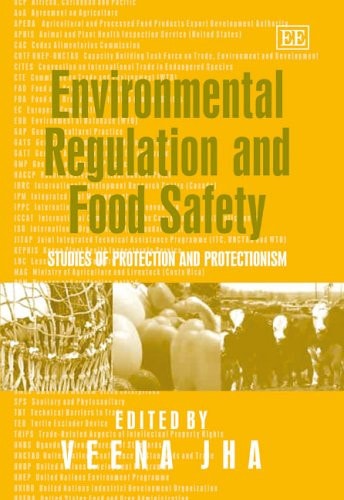
Environmental Regulation and Food Safety: Studies of Protection and Protectionism
0
0
As an Amazon Associate and affiliate partner, Menrva Books earns from qualifying purchases. Learn more
Author Description
Product Description Environmental, health and sanitary requirements in developed countries are sometimes perceived in developing countries as non-tariff barriers to trade. This book shows that such restrictions are perceived to be more stringent during the domestic production season or when stock levels are high. The authors argue that scientific data for specific thresholds or limit values sometimes appear to be questionable and that they vary widely between countries. In some cases, products that had initially been refused access to a domestic market have subsequently been allowed access but at a lower price. Thus standards are perceived to be a mechanism for bidding down the export price. Countries from the same region with similar water or climatic conditions may be subject to differential degrees of Sanitary and Phytosanitary measures (SPS). Measures to address protectionist aspects of standards must be devised to ensure free and fair trade.The contributors to this book show that there are good reasons for suspecting that these standards could indeed be protectionist. Utilising a wealth of empirical evidence, the book includes case studies written by authors based in the regions and does not fail to address awkward issues such as 'whose standards?', 'why standards?' and whether cartelisation is the consequence of standards. The contributors also address the political economy of standard setting, not simply the technical process, north-south issues and the political economy of organic food markets. Environmental Regulation and Food Safety will appeal to policymakers and NGOs, researchers and scholars of international and development economics as well as industry strategists. Copublished with Canada's International Development Research Centre. About the Author Edited by Veena Jha, formerly Coordinator, UNCTAD’s India Programme, New Delhi, India
Menrva's Summary
THE THESIS
This book investigates whether environmental and food safety regulations function as disguised protectionist measures, particularly impacting developing countries. It examines how stringent requirements, often perceived as non-tariff barriers, can be manipulated to suppress export prices and create unfair trade advantages. The authors explore the variability and questionable scientific basis of some international standards, highlighting instances where similar regions face differential treatment, and argue for measures to ensure equitable global trade.
THE SCOPE MAP
- Analysis of environmental, health, and sanitary requirements as potential non-tariff barriers to trade.
- Examination of how domestic production seasons and stock levels influence the stringency of these requirements.
- Discussion on the questionable scientific data and wide variations in product thresholds and limit values between countries.
- Case studies from authors based in affected regions, providing empirical evidence.
- Exploration of standards as a mechanism for bidding down export prices.
- Investigation into differential degrees of Sanitary and Phytosanitary (SPS) measures applied to countries with similar conditions.
- Analysis of the political economy of standard setting, including north-south issues and organic food markets.
- Consideration of whether cartelization is a consequence of standard setting.
THE AUTHORITY PERSPECTIVE
The book's contributors present a compelling argument, supported by extensive empirical evidence and regional case studies, that international environmental and food safety standards may indeed serve protectionist aims. It delves into critical questions regarding the origin and purpose of these standards, and whether they lead to market cartelization. The work is noted for addressing the political economy of standard setting, including the dynamics of organic food markets, making it a valuable resource for policymakers, NGOs, researchers, and industry strategists.
Page Count:
256
Publication Date:
2006-03-27
Publisher:
Edward Elgar Publishing
ISBN-10:
184542512X
ISBN-13:
9781845425128
Economics
Non-Fiction
International Trade
Protectionism
Food Safety
Community Tags
Other Editions(2)
Similar Books


Reader Comments
Share Your Thoughts
No comments yet. Be the first to share your thoughts!