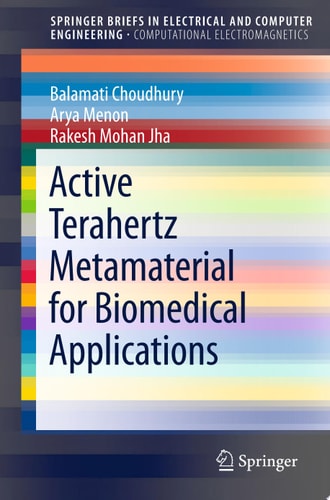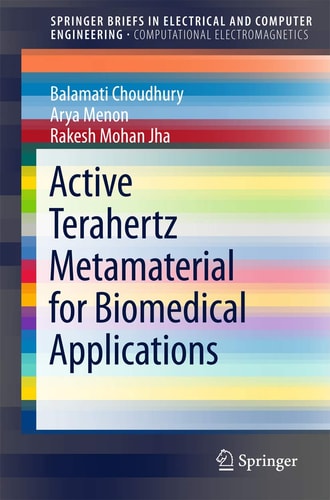
Active Terahertz Metamaterial for Biomedical Applications
0
0
As an Amazon Associate and affiliate partner, Menrva Books earns from qualifying purchases. Learn more
Author Description
This book describes a metamaterial-based active absorber for potential biomedical engineering applications. Terahertz (THz) spectroscopy is an important tool for imaging in the field of biomedical engineering, due to the non-invasive, non-ionizing nature of terahertz radiation coupled with its propagation characteristics in water, which allows the operator to obtain high-contrast images of skin cancers, burns, etc. without detrimental effects. In order to tap this huge potential, it is important to build highly efficient biomedical imaging systems by introducing terahertz absorbers into biomedical detectors. The biggest challenge faced in the fulfilment of this objective is the lack of naturally occurring dielectrics, which is overcome with the use of artificially engineered resonant materials, viz. metamaterials. This book describes such a metamaterial-based active absorber. The design has been optimized using particle swarm optimization (PSO), eventually resulting in an ultra-thin active terahertz absorber. The absorber shows near unity absorption for a tuning range of terahertz (THz) application.
Menrva's Summary
THE THESIS
This book details the design and optimization of an active metamaterial-based absorber for biomedical terahertz applications. The authors address the challenge of limited naturally occurring dielectrics in terahertz spectroscopy by presenting an artificially engineered resonant material. The proposed absorber, optimized using particle swarm optimization (PSO), achieves near-unity absorption across a tunable terahertz range, offering potential for high-contrast, non-invasive imaging in fields like skin cancer detection.
THE SCOPE MAP
- Description of a metamaterial-based active absorber for terahertz applications.
- Explanation of terahertz spectroscopy's utility in non-invasive biomedical imaging.
- Discussion of challenges in terahertz imaging, specifically the lack of suitable dielectrics.
- Details on the optimization process using particle swarm optimization (PSO).
- Presentation of an ultra-thin active terahertz absorber design.
- Analysis of the absorber's performance, showing near unity absorption.
- Potential applications in biomedical engineering, including skin cancer and burn imaging.
THE AUTHORITY PERSPECTIVE
This work presents a specialized technical exploration into active terahertz metamaterials for biomedical imaging. The authors detail a specific design optimized through particle swarm optimization, highlighting its potential for high-contrast, non-invasive imaging applications. The book focuses on overcoming material limitations in terahertz spectroscopy by employing engineered resonant structures.
Page Count:
49
Publication Date:
2015-09-30
Publisher:
Springer Nature Singapore
ISBN-10:
9812877924
ISBN-13:
9789812877925
Non-Fiction
Science
Biomedical Engineering