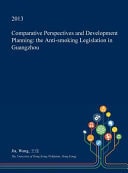
Comparative Perspectives and Development Planning: The Anti-Smoking Legislation in Guangzhou
0
0
As an Amazon Associate and affiliate partner, Menrva Books earns from qualifying purchases. Learn more
Author Description
This dissertation, "Comparative Perspectives and Development Planning: the Anti-smoking Legislation in Guangzhou" by Jia, Wang,, was obtained from The University of Hong Kong (Pokfulam, Hong Kong) and is being sold pursuant to Creative Commons: Attribution 3.0 Hong Kong License. The content of this dissertation has not been altered in any way. We have altered the formatting in order to facilitate the ease of printing and reading of the dissertation. All rights not granted by the above license are retained by the author. Abstract: The large proportion of smokers in China and the social consequences have had a damaging impact on public health as well as on the society. As a sub-national legislation, the Guangzhou anti-smoking legislations in Guangzhou play an important role in the legislative control in China since it is one of the most severe local tobacco control laws in China. Many legislative experts, public health professionals and even decision makers have great hope on this law. But the consequence of this law is disappointed. And this anti-smoking legislation has exposed a lot of problems. This article introduces the current status of tobacco control legislation in Guangzhou; analyzes the effectiveness of Hong Kong and Canada's tobacco control law; identifies four areas (the weak effect of the anti-smoking law; inappropriate penalties; limited governmental capacity and uncertain political will and the lack of awareness) in the anti-smoking legislation in Guangzhou that are problematic. Finally, this project discusses what can we learn from other countries' legislative experiences, including making clear definitions of key terms in anti-smoking laws; change the way of penalty; increasing the regulation of tobacco packaging and increasing the governmental capacity, which aims at proposing some legislative options for a much more effective tobacco control movement in Guangzhou in the future. DOI: 10.5353/th_b5098894 Subjects: Smoking - La
Menrva's Summary
THE THESIS
This dissertation investigates the effectiveness of anti-smoking legislation in Guangzhou, China, by examining its shortcomings and proposing improvements based on international models. The author, Jia Wang, analyzes the current status of tobacco control laws in Guangzhou, a jurisdiction with one of China's most stringent local tobacco control laws, yet one that has yielded disappointing results. The study identifies key problem areas including the law's weak effect, inappropriate penalties, limited governmental capacity, and uncertain political will, alongside a general lack of public awareness. By comparing Guangzhou's legislation with successful models from Hong Kong and Canada, the dissertation aims to offer legislative options for a more effective future tobacco control movement.
THE SCOPE MAP
- Analysis of the current status of tobacco control legislation in Guangzhou.
- Comparative effectiveness of tobacco control laws in Hong Kong and Canada.
- Identification of four problematic areas in Guangzhou's anti-smoking legislation: weak effect, inappropriate penalties, limited governmental capacity, and uncertain political will.
- Discussion of the lack of public awareness regarding anti-smoking measures.
- Proposals for legislative improvements based on international experiences.
- Recommendations for clearer definitions of key terms in anti-smoking laws.
- Suggestions for changing penalty structures and increasing regulation of tobacco packaging.
- Emphasis on increasing governmental capacity for tobacco control.
THE AUTHORITY PERSPECTIVE
This dissertation is presented as a rigorous academic study, likely to be of interest to policymakers, public health professionals, and legal scholars concerned with tobacco control in China. The abstract suggests a critical analysis of existing legislation, highlighting its failures and drawing lessons from international best practices. The work appears to offer concrete, actionable recommendations for improving future tobacco control efforts in Guangzhou and potentially other regions facing similar challenges. The detailed examination of specific legislative and enforcement issues indicates a focused and evidence-based approach.
Page Count:
0
Publication Date:
2017-01-26
Publisher:
BiblioBazaar
ISBN-10:
1361325429
ISBN-13:
9781361325421
Health
Non-Fiction
Politics
Government
Law
Public Health
China Studies
Social Science
Community Tags
Similar Books







Reader Comments
Share Your Thoughts
No comments yet. Be the first to share your thoughts!