A Phenomenology of Institutions: Relationality and Governance in China and Beyond
0
0
As an Amazon Associate and affiliate partner, Menrva Books earns from qualifying purchases. Learn more
Author Description
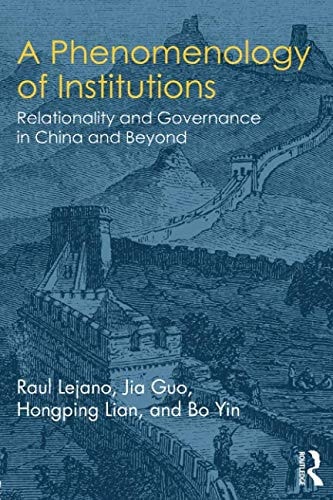
To a degree insufficiently captured by the term governance, the present age is one of institutional complexity. China is a case in point. An amalgam of socialist, capitalist, corporatist, and pluralist characteristics, China's systems of governance defy classification using extant categories in the institutionalist literature. What, after all, is a socialist market system? A Phenomenology of Institutions begins with the problem of describing emergent institutional phenomena using conventional typologies. Constructing a new descriptive framework for rendering new, hybrid, and flexible institutional designs, Raul Lejano, Jia Guo, Hongping Lian, and Bo Yin propose new descriptors, involving concepts of autopoeisis, textuality, and relationality, that might better describe new and emergent models of governance. The authors illustrate the utility of this framework with a number of case studies, each dealing with a different aspect of Chinese legal and civic institutions and comparing these with 'Western' models. This book will be a valuable resource for institutional scholars in the fields of public policy, political science, organization studies, public administration, and international development, studying new and emergent forms of governance.
Menrva's Summary
THE THESIS
This book investigates the challenges of classifying and describing complex, emergent institutional phenomena, particularly within China's unique governance systems. The authors address the inadequacy of existing institutionalist literature to categorize hybrid models by proposing a new descriptive framework. This framework incorporates concepts such as autopoeisis, textuality, and relationality to better capture new and flexible institutional designs. Through case studies of Chinese legal and civic institutions, compared with Western models, the book demonstrates the utility of this novel approach.
THE SCOPE MAP
- Analysis of China's hybrid governance systems, blending socialist, capitalist, corporatist, and pluralist characteristics.
- A new descriptive framework for emergent institutional phenomena, utilizing concepts of autopoeisis, textuality, and relationality.
- Case studies examining various aspects of Chinese legal and civic institutions.
- Comparative analysis of Chinese institutional models with 'Western' models.
- Discussion relevant to scholars in public policy, political science, organization studies, public administration, and international development.
THE AUTHORITY PERSPECTIVE
This book is positioned as a valuable resource for scholars in public policy, political science, organization studies, public administration, and international development who are studying new and emergent forms of governance. The authors' proposed framework, incorporating concepts like autopoeisis and relationality, aims to provide a more nuanced understanding of complex institutional designs. The comparative case studies of Chinese institutions against Western models are intended to illustrate the practical application and utility of their theoretical approach. The work seeks to advance the descriptive capabilities within institutionalist literature.
Page Count:
149
Publication Date:
2019-01-01
Publisher:
Routledge
ISBN-10:
1138667366
ISBN-13:
9781138667365
Non-Fiction
Politics
Economics
Legal Studies
International Development
Public Administration
Sociology
Community Tags
Similar Books