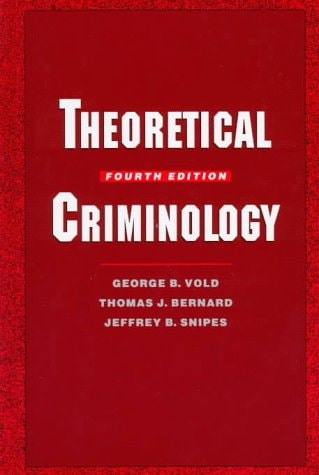
Theoretical Criminology
0
0
As an Amazon Associate and affiliate partner, Menrva Books earns from qualifying purchases. Learn more
Author Description
This fourth edition of Theoretical Criminology, the standard text and reference in its field, has been extensively revised and completely updated. New sections include material on neurotransmitters, environmentally induced biological components of behavior, impulsiveness and crime, neighborhoods as causes of crime, situational contexts of crime, the decline and resurgence of strain theories, and control-ology. The text also examines Gottfredson and Hirsch's General Theory of Crime, Katz's Seductions of Crime, Hagan's Structural Criminology, and Black's Behavior of Law, as well as postmodern criminology and feminist criminology. A new chapter on developmental criminology discusses criminal careers, longitudinal research, the relationship between age and crime, Thornberry's interactional theory, and Sampson and Laub's age-graded theory of informal social control. A second new chapter on integrated theories discusses recent efforts by Elliott et al., Braithwaite, Tittle, Vila, and Bernard and Snipes.The text presents each type of theory accurately and comprehensively within its historical context. Relevant empirical research is reviewed and assessed, and research issues related to theory testing are also discussed. The writing style is lively and readable, designed to appeal to students at all levels. Offering the most accurate, clear, and comprehensive presentation of criminology theories, Theoretical Criminology continues to retain its premier position in the field of criminology, a position it has held for almost 40 years.
Menrva's Summary
THE THESIS
This text investigates the historical development and current state of criminological theory to provide a comprehensive framework for understanding criminal behavior. The authors, including Bernard, Snipes, and the late Vold, synthesize decades of research to evaluate how various sociological, biological, and psychological theories explain the etiology of crime. By situating each theory within its specific historical context, the work offers a rigorous assessment of empirical evidence and the methodological challenges inherent in testing these models.
THE SCOPE MAP
What You Will Find
- Comprehensive analysis of classical and contemporary criminological theories including strain, control, and developmental models.
- Examination of biological and environmental factors such as neurotransmitters and neighborhood influence.
- Review of specialized frameworks like feminist criminology, postmodernism, and integrated theory.
- Assessment of empirical research methodologies and the relationship between theory and practice.
THE AUTHORITY PERSPECTIVE
Experts and academics recognize this work as a foundational text that has maintained its status in the field for nearly four decades. Readers frequently note the clarity of the prose, which balances academic rigor with accessibility for students at various levels of study.
Page Count:
368
Publication Date:
1997-08-14
Publisher:
Oxford University Press
ISBN-10:
0195073215
ISBN-13:
9780195073218
Sociology
Law
Academic
Social Science
Criminology
Criminal Anthropology
Community Tags
Similar Books