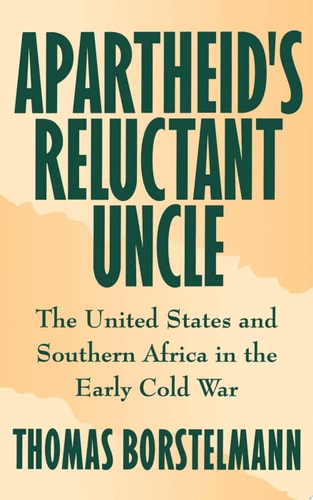
Apartheid's Reluctant Uncle: The United States and Southern Africa in the Early Cold War
0
0
As an Amazon Associate and affiliate partner, Menrva Books earns from qualifying purchases. Learn more
Author Description
In 1948, civil rights for black Americans stood higher on the national political agenda than at any time since Reconstruction. President Harry Truman issued orders for fair employment and the integration of the armed forces, and he proceeded to campaign on a platform that included an unprecedented civil rights plank, pushed through the Democratic convention by Hubert Humphrey. But on the other side of the globe, his administration paid close attention to another election as well: the surprising triumph of the white-supremacist National Party in South Africa, reluctantly accepted by the Truman White House.Apartheid's Reluctant Uncle brings to light the neglected history of Washington's strong (but hushed) backing for the National Party government after it won power in 1948, and its formal establishment of apartheid. Thomas Borstelmann's account weaves together the complex threads of early Cold War tensions, African and domestic American politics, and nuclear diplomacy to show how--and why--the United States government aided and abetted the evangelically racist regime in Pretoria. Despite the rhetoric of the "free world," and the lingering idealism following the defeat of Nazi Germany and the founding of the U.N., Truman's foreign policy was focused on limiting Soviet expansion at all costs. Tensions between the two former allies mounted in Europe, the Middle East, and Asia, with the Berlin crisis, the Greek civil war, and the impending victory of the Communists in China. In southern Africa, the United States sought to limit Soviet and left-wing influence by supporting the colonial powers (Belgium, Portugal, and of course Britain) and the fiercely anticommunist National Party, led by Daniel Malan. Despite the unsavory racism of Malan's government--Borstelmann shows that Pretoria fomented violence among black groups in the late 1940s, just as it has done recently between the ANC and Inkatha--the U.S. saw South Africa as a dependable and important ally. In addition, Ame
Menrva's Summary
THE THESIS
This work investigates the geopolitical motivations that led the United States to maintain a strategic alliance with South Africa's apartheid regime during the early Cold War. Thomas Borstelmann, a historian specializing in U.S. foreign policy and race relations, utilizes archival records and diplomatic correspondence to argue that the Truman administration prioritized anti-communist containment over human rights concerns. By examining the intersection of domestic civil rights progress and international realpolitik, the author demonstrates how the U.S. government rationalized its support for the National Party to secure regional stability and mineral resources.
THE SCOPE MAP
What You Will Find
- Analysis of U.S. diplomatic relations with South Africa between 1948 and the early 1950s.
- Examination of the Truman administration's domestic civil rights agenda versus its foreign policy contradictions.
- Evaluation of nuclear diplomacy and the strategic importance of South African mineral exports.
- Assessment of how Cold War containment strategies influenced American support for colonial powers in Africa.
THE AUTHORITY PERSPECTIVE
Historians and political scientists frequently cite this text as a critical examination of the moral compromises inherent in early Cold War foreign policy. Scholars note the author's ability to synthesize complex diplomatic history with the domestic political climate of the post-war United States.
Page Count:
320
Publication Date:
1993-06-24
Publisher:
Oxford University Press
ISBN-10:
0195079426
ISBN-13:
9780195079425
History
United States
African history
International relations
Cold War
Race Relations