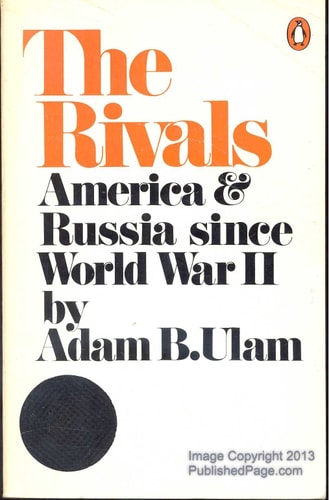
The Rivals
0
0
As an Amazon Associate and affiliate partner, Menrva Books earns from qualifying purchases. Learn more
Author Description
A challenging study of Russia's and America's policies and attitudes toward each other since World War II. It is not a usual study of the Cold War, or just of international relations, but a sharp, thought-provoking analysis of the methods, madnesses, mistakes, and success of policy-making on both sides during each major crisis or turn of events from the Normandy invasion to the war in Vietnam.
Menrva's Summary
THE THESIS
This work investigates the complex interplay of policy-making, strategic errors, and ideological motivations that defined the relationship between the United States and the Soviet Union following World War II. Adam B. Ulam, a noted scholar of Russian history and international affairs, utilizes a critical analytical framework to examine how both superpowers navigated major geopolitical crises. By focusing on the internal logic and external pressures of each government, the author evaluates the successes and failures of diplomatic and military strategies from the Normandy invasion through the Vietnam War.
THE SCOPE MAP
What You Will Find
- Analysis of diplomatic policy-making during the Cold War era
- Examination of major international crises from 1945 to the Vietnam War
- Comparative study of American and Soviet political attitudes
- Evaluation of strategic decision-making processes
Scope Limits
- Does not provide a comprehensive military history of the Cold War
- Focuses primarily on high-level policy rather than grassroots social movements
THE AUTHORITY PERSPECTIVE
Experts frequently cite this work as a significant contribution to the study of Cold War diplomacy due to its focus on the internal political dynamics of both nations. Readers often note the analytical depth of the prose, which moves beyond standard historical narratives to examine the specific motivations behind superpower policy.
Page Count:
405
Publication Date:
1972-09-20
Publisher:
Penguin Books
ISBN-10:
0140043098
ISBN-13:
9780140043099
History
Cold War
International relations
American History
Russian History
Community Tags
Similar Books