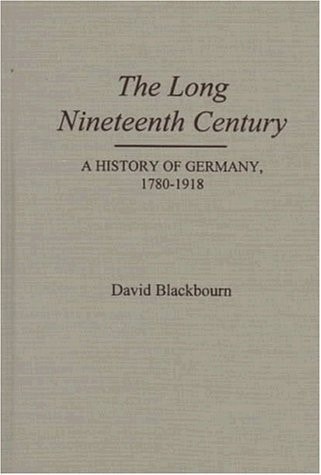
The Long Nineteenth Century: A History of Germany, 1780-1918
0
0
As an Amazon Associate and affiliate partner, Menrva Books earns from qualifying purchases. Learn more
Author Description
In the late eighteenth century, German-speaking Europe was a patchwork of principalities and lordships. Most people lived in the countryside, and just half survived until their late twenties. By the beginning of our own century, unified Germany was the most powerful state in Europe. No longer a provincial "land of poets and thinkers," the country had been transformed into an industrial and military giant with an advanced welfare system.The Long Nineteenth Century: A History of Germany, 1780-1918, is a masterful account of this transformation. Spanning 150 years, from the eve of the French Revolution to the end of World War I, it introduces readers to crucial areas of German social and cultural history -- demography and social structure, work and leisure, education and religion -- while providing a comprehensive account of political events. The text explains how Germany came to be unified, and the consequences of that unification. It describes the growing role of the state and new ways in which rulers asserted their authority, but questions cliches about German "obedience." Drawing on a generation of work devoted to migration, housing, crime, medicine, and popular culture, Blackbourn offers a powerful and original account of a changing society, trying to do justice to the experiences of contemporary Germans, both women and men. Informed by the latest scholarship, this book provides a complete and up-to-date alternative to conventional political histories of this period.
Menrva's Summary
THE THESIS
How did a fragmented collection of German-speaking principalities evolve into the most powerful industrial and military state in Europe by the early twentieth century? David Blackbourn, a distinguished historian of modern Germany, utilizes a broad analytical framework to examine the structural shifts within German society from 1780 to 1918. By integrating social, cultural, and political data, he challenges traditional narratives that focus exclusively on elite political maneuvering and state-building. The text argues that the transformation of Germany was a complex process involving demographic shifts, economic industrialization, and evolving social identities that extended far beyond the actions of rulers.
THE SCOPE MAP
What You Will Find
- Comprehensive analysis of German social and cultural history, including demography, religion, and education.
- Examination of the transition from a rural, agrarian society to an industrial and military powerhouse.
- Integration of diverse historical evidence, including migration patterns, housing, crime, and medicine.
- Critical evaluation of the political unification process and the subsequent role of the state in daily life.
THE AUTHORITY PERSPECTIVE
Historians and scholars frequently cite this work as a foundational text that successfully balances political narrative with social history. Readers often note the clarity of the prose and the author's ability to synthesize vast amounts of scholarship into a coherent, accessible account of the period.
Page Count:
624
Publication Date:
1998-01-08
Publisher:
Oxford University Press
ISBN-10:
0195076710
ISBN-13:
9780195076714
History
European History
Political History
German history
Social History
Germany
Community Tags
Similar Books