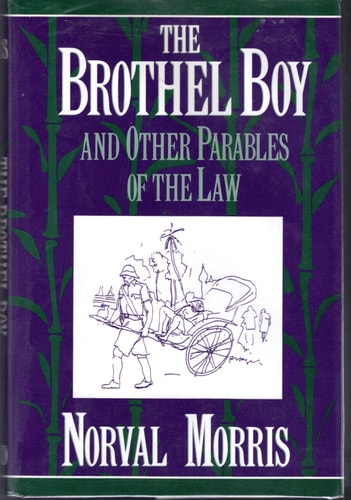
The Brothel Boy and Other Parables of the Law
0
0
As an Amazon Associate and affiliate partner, Menrva Books earns from qualifying purchases. Learn more
Author Description
The mystery does not always end when the crime has been solved. Indeed, the most insolvable problems of crime and punishment are not so much who committed the crime, but how to see that justice is done. Now, in this illuminating volume, one of America's great legal thinkers, Norval Morris, addresses some of the most perplexing and controversial questions of justice in a highly singular fashion--by examining them in fictional form, in what he calls "parables of the law."The protagonist of these stories, the figure who must see that justice is done, is Eric Blair, a name familiar to most readers: it's the real name of George Orwell. In fact, Morris has set his tales in the time and place of Orwell's famous essay, "Shooting an Elephant," in Moulmein, Burma, in the 1920s. What might seem a curious strategy at first glance--borrowing Orwell's persona to narrate these tales--is actually a brilliant stroke. For in Eric Blair we have an ideal narrator to highlight the complexities of justice: an untrained police lieutenant and junior magistrate, uncertain of judgement--and all the more likely to anguish over judgement, and to examine every facet of a case before deciding. And in 1920s Moulmein we have a neutral time and space in which to consider--free of our own political, religious, or social prejudices--a set of contemporary legal and moral questions that rarely find so calm an arena. And these stories certainly address some highly charged issues--capital punishment, insanity as a murder defense, the "battered wife syndrome" as a murder defense, child custody, "parental neglect" due to religious conviction--to name a few. In each tale, Norval Morris excels at placing Blair at the center of a controversy that has no easy answer, and that he and he alone must decide. In the title story, for instance, a retarded boy, whose only understanding of sex comes from the brothel in which he works, accidentally murders a young girl while raping her, his only defense being "Please si
Menrva's Summary
THE PULSE
Eric Blair, a young police lieutenant in 1920s Burma, must navigate the agonizing moral and legal complexities of justice while serving as a junior magistrate. Tasked with resolving cases that lack clear moral resolution, Blair finds himself caught between the rigid requirements of the law and the messy reality of human behavior. The narrative utilizes a series of parables to explore the weight of judicial authority, forcing the protagonist to confront his own uncertainty and the limitations of the colonial legal system. Through this non-linear collection of stories, the author examines the intersection of personal conscience and institutional duty.
INSIDE THE PAGES
- Use of a historical persona, Eric Blair, as a surrogate for the author's legal inquiries.
- Setting established in 1920s colonial Burma to provide a neutral backdrop for moral debate.
- Episodic narrative structure organized as a series of legal parables.
- Focus on high-stakes ethical dilemmas including capital punishment and the insanity defense.
- Examination of the psychological burden placed upon a junior magistrate.
- Integration of real-world legal concepts into fictionalized scenarios.
- Exploration of the tension between cultural norms and colonial law.
- Character-driven investigation of the nature of culpability and justice.
THE COLLECTIVE ECHO
Readers frequently highlight the unique effectiveness of using George Orwell's original persona to frame complex legal debates. Discussion often centers on how the colonial setting strips away modern biases, allowing for a more clinical examination of the moral questions presented in each case. Critics note that the pacing is deliberate, prioritizing intellectual engagement over traditional suspense or action sequences. The balance between character development and philosophical inquiry remains a primary point of interest for those interested in the intersection of law and literature. Many find the author's ability to present unsolvable problems without offering easy answers to be the most compelling aspect of the collection.
Page Count:
352
Publication Date:
1992-05-28
Publisher:
Oxford University Press
ISBN-10:
0195074432
ISBN-13:
9780195074437
Crime
Fiction
Legal Thriller
Punishment
Historical
Short Stories
Criminal Law
Community Tags
Other Editions(2)

Similar Books


Reader Comments
Share Your Thoughts
No comments yet. Be the first to share your thoughts!